A starting bake time computed from pan geometry, with the oven temperature convention and the doneness tests.
Quick answer
An 8 inch round pan filled two thirds starts checking at 25 minutes and usually runs 25 to 40 minutes at 350 F. This is a computed estimate from the pan geometry, not a tested time, and home ovens vary by more than the width of that band, so the doneness test decides.
The formula
minutes = 3.79 x depth^1.3 x area^0.45 x (350 / temp F)^1.5
It is worth being plain about where this comes from, because most bake-time charts do not say. It is arithmetic on the pan dimensions, and the exponents are what matter: batter depth carries the largest one because heat travels in from the wall and up from the floor, floor area matters less, and temperature enters as roughly its inverse three-halves power.
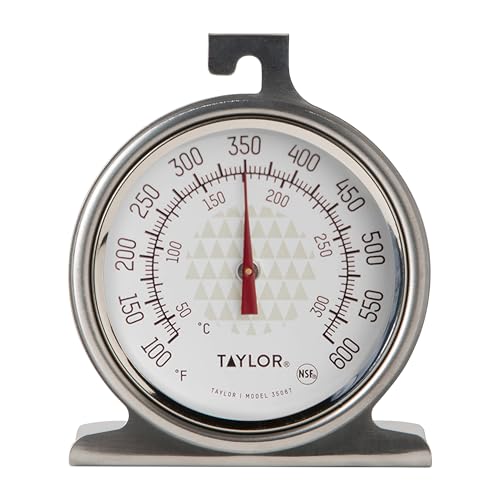
The band is wide on purpose. A home oven reading 350 F on its dial is routinely 25 F out in either direction, which moves a bake time further than any of this arithmetic does. An oven thermometer is the cheapest useful thing you can buy for baking.
Past about 12 inches the outside of a cake sets long before the middle. Bake-even strips and a heating core are the usual answers, and both change the time.
Derived, published or convention?
This is TRADE CONVENTION and a COMPUTED ESTIMATE. Nobody baked a cake with a stopwatch to produce it, and no figure here should be treated as tested. The doneness tests below are what actually decide.
Estimated bake time by pan, filled two thirds
Pan
Batter depth (in)
Oven (F)
Start checking (min)
Expected range (min)
6 in round
1.33
350
20
20 to 30
8 in round
1.33
350
25
25 to 40
9 in round
1.33
350
30
30 to 45
10 in round
1.33
325
35
35 to 55
12 in round
1.33
325
45
45 to 65
14 in round
1.33
325
50
50 to 75
8 x 8 in square
1.33
350
30
30 to 45
10 x 10 in square
1.33
325
40
40 to 60
9 x 13 in rectangle
1.33
350
40
40 to 60
12 x 18 in rectangle
1.33
325
60
60 to 85
Computed estimates from pan geometry, not tested times. The oven temperature follows the convention of 350 F under a 10 inch span at 2 inches deep, and 325 F above that or for 3 inch pans.
Gear for these numbers
These are rendered from the verified catalog and re-ordered against your numbers once you calculate.
Home ovens routinely run 25 F or more off their dial, which is the real reason a bake time chart never matches your oven, and this is the cheapest way to find out by how much.
Damp strips around the pan slow the outside so the middle catches up, which is what stops a dome forming and saves you levelling off the top and throwing it away.
Amazon prices move often, so check before you buy.
Questions people ask
How do I tell when a cake is actually done?
The middle springs back when pressed lightly and leaves no dent. A skewer in the centre comes out with moist crumbs clinging to it rather than wet batter. The edges have pulled very slightly away from the pan wall, and the surface has stopped hissing, which is the sound of water still boiling off. Any one of those beats a clock.
Why is the bake time a range rather than a number?
Because a single number would be false precision. This figure is computed from pan geometry rather than measured, and home ovens commonly run 25 F away from their dial in either direction, which shifts a bake time by more than the whole range. Treat the low end as the moment to start checking and let the doneness test decide the rest.
Should I bake at 325 F or 350 F?
The convention is 350 F for layer pans under a 10 inch span at 2 inches deep, and 325 F once the shortest span reaches 10 inches or the pan is 3 inches deep. Dropping 25 F always costs time and always gives a flatter, paler cake, so it is a trade rather than an improvement. A 9 by 13 bakes at 350 F despite its area, because no part of it is more than 4.5 inches from a wall.
Do bake-even strips change the bake time?
Yes, usually adding a few minutes, and they are worth it anyway. A damp strip around the pan slows the outside so the middle catches up, which stops a dome forming. The cake finishes flat enough to stack without levelling, so the extra minutes buy back the cake you would otherwise cut off the top and throw away.
This calculator does arithmetic on the numbers you give it. It does not know your oven, your recipe or
your altitude. Figures are labelled as derived, published or trade convention, and where no honest
figure exists the calculator says so instead of producing one. Researched guidance, not professional advice.