Quick answer
Dark couverture melts at 115 to 120 F, cools to 82 to 84 F, then works at 88 to 90 F. Milk chocolate runs about 5 degrees cooler at each stage; white chocolate cooler still, at 105 to 110, 78 to 80 and 84 to 86 F. These are published couverture manufacturer ranges, not one universal number.

ThermoWorks Thermapen ONE Instant-Read Thermometer
A one second reading, which is what makes it usable for Swiss meringue where you are holding a whisk in the other hand and the syrup is still climbing.
Best for: Swiss and Italian meringue, and sugar work
Check price on AmazonTempering chocolate is a three-stage temperature ladder, and the ladder shifts depending on which chocolate is in the bowl. Dark couverture melts fully at 115 to 120 F, cools to 82 to 84 F to seed the stable crystal, then comes back up to 88 to 90 F to work. Milk chocolate runs the same three stages about 5 degrees cooler throughout, and white chocolate cooler again, because milk solids and a higher cocoa butter fraction change how the fat sets.
The numbers on this page are published couverture manufacturer ranges, closest to the working charts printed by Callebaut, Valrhona and Guittard. Every bag prints its own version of this ladder, usually within a degree or two of the figures here, and the number on the bag always beats a chart. Run a batch through the chocolate tempering calculator, or check ratios for a ganache made from the same chocolate on the ganache calculator.
The reason any of this matters is a shape of fat crystal, not flavor. Cocoa butter can set into six different crystal structures, and only one of them, the one tempering aims for, gives a hard snap, a glossy surface and a clean release from a mold. The other five are soft, dull or unstable, and untempered chocolate that looks fine when it first sets can slide into one of those weaker forms days later, which is what fat bloom actually is.
What temperature do you melt, cool and work each type of chocolate to?
Each stage does a different job. Melting fully erases every existing crystal type so the chocolate starts from a clean slate. Cooling into the seed band forms the one stable crystal that gives chocolate its snap and shine. Working brings the chocolate back up just far enough to stay fluid without melting that seed crystal back out.
| Chocolate type | Stage | Temperature (F) | Purpose |
|---|---|---|---|
| Dark (54 to 70 percent) | Melt | 115 to 120 | Fully melts the cocoa butter and destroys every existing crystal form |
| Dark (54 to 70 percent) | Cool | 82 to 84 | Seeds the stable crystal as the fat begins to set |
| Dark (54 to 70 percent) | Work | 88 to 90 | Rewarmed just enough to stay fluid without melting the seed crystal out |
| Milk (31 to 40 percent) | Melt | 110 to 115 | Fully melts; lower than dark because milk solids lower the melting point |
| Milk (31 to 40 percent) | Cool | 80 to 82 | Seeds the stable crystal in a chocolate that carries less cocoa butter |
| Milk (31 to 40 percent) | Work | 86 to 88 | Working band about 2 degrees below dark at every stage |
| White (28 to 35 percent cocoa butter) | Melt | 105 to 110 | Fully melts; white chocolate has no cocoa solids, only cocoa butter |
| White (28 to 35 percent cocoa butter) | Cool | 78 to 80 | Seeds the crystal in a chocolate that sets on cocoa butter alone |
| White (28 to 35 percent cocoa butter) | Work | 84 to 86 | The lowest working band of the three; white chocolate is the most heat sensitive |
Why does chocolate bloom or streak instead of setting glossy?
Most tempering failures trace back to one of the three bands above, either overshooting it or drifting through it too fast to seed properly.
| What you see | Likely cause | What to change |
|---|---|---|
| Sets dull and streaky instead of glossy | Worked above the work-temperature band | Cool back down through the seed band, then rework at the correct temperature |
| Thickens or seizes while cooling | Cooled below the low end of the cool band | Gently rewarm to the melt band and start the cycle again |
| Grey-white blotches appear once set | Chocolate never reached a stable crystal, usually from working too warm | Retemper from the melt stage; a fan or a warm room while it sets makes this worse |
| Fine white speckling appears within a day or two | Stored somewhere warm after setting | Cool storage after setting matters as much as the tempering itself |
| A gritty white coating appears rather than a bloom | Condensation reached the surface before it set | Keep chocolate away from steam and refrigerator condensation; this is not a tempering fault |
| Will not release cleanly from a mold | Not tempered at all, or worked well above the band | Check a small test strip on parchment before molding a full batch |
How do I know chocolate is actually in temper before I use it?
Dip the tip of a knife or an offset spatula in the chocolate and let it sit at room temperature for three to five minutes. In-temper chocolate sets matte to semi-gloss and firm within that window, with no streaking. If it stays soft, tacky or streaky after five minutes, it needs another pass through the cool and work stages before use.
An instant-read thermometer that reads to a tenth of a degree matters more here than almost anywhere else in cake decorating, because the seed band for each chocolate type is only 2 degrees wide. A thermometer that is only accurate to the nearest degree can put a batch outside the band with no warning at all.
Working in small batches makes all of this easier to control. A pound of chocolate loses heat and gains it back far more slowly than a few ounces, so a small test batch on a marble slab or over a bowl of warm water responds to a stir or a splash of warm chocolate within seconds rather than minutes. Scale up only once a small batch has proven the timing for a specific chocolate and a specific room.
Is tabling on marble different from seeding with already-tempered chocolate?
Both reach the same three temperature stages; they differ only in how the cooling stage happens. Tabling spreads about two thirds of the melted chocolate across a cool marble or granite surface and works it with a spatula until it thickens, which cools it quickly and mechanically forms the stable crystal before it is stirred back into the remaining warm chocolate to reach the work temperature. Seeding skips the marble and instead stirs in already-tempered chopped chocolate or callets, which supply the stable crystal directly and pull the whole batch's temperature down into the cool band as they melt.
Tabling gives more direct control over exactly how far the temperature drops and is the standard in professional kitchens working with several pounds at once. Seeding is faster, needs no marble slab, and is the more forgiving method for a home kitchen working with a pound or two, provided the seed chocolate itself is genuinely in temper before it goes in.
What this job actually needs
ThermoWorks Thermapen ONE Instant-Read Thermometer
$125.00A one second reading, which is what makes it usable for Swiss meringue where you are holding a whisk in the other hand and the syrup is still climbing.
Best for: Swiss and Italian meringue, and sugar work
Check price on AmazonAmazon prices move often, so check before you buy.

Callebaut No. 811 Finest Belgian Dark Chocolate Callets, 1 kg
$44.85The reference dark couverture at about 54 percent, in callets that melt evenly, which is what the published tempering ranges on this site assume.
Best for: ganache, tempering and drips
Check price on AmazonAmazon prices move often, so check before you buy.
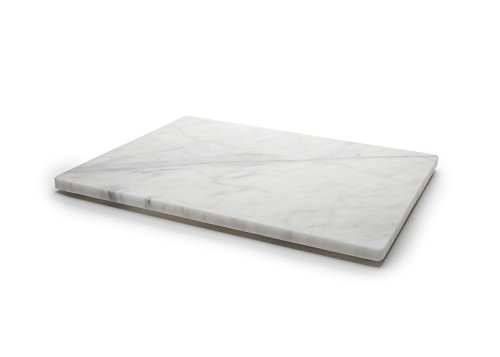
Fox Run Marble Pastry Board, 16 x 20 in
$70.39Marble stays below room temperature, which is why it is the traditional surface for tempering chocolate by tabling and for rolling fondant without it going sticky.
Best for: tabling chocolate and rolling fondant
Check price on AmazonAmazon prices move often, so check before you buy.
Questions people ask
- Why does dark chocolate temper at a higher temperature than white chocolate?
- Dark chocolate carries the most cocoa solids and cocoa butter of the three, both of which need a higher temperature to fully melt and a higher temperature to reseed. White chocolate has no cocoa solids at all and sets on cocoa butter alone, which melts and reseeds at a lower temperature. Milk chocolate sits in between, with milk solids and sugar standing in for some of the cocoa solids. The three-stage shape of the process is identical for all three; only the numbers move.
- Can I use the same thermometer reading for the melt stage and the work stage?
- No, they are two different targets roughly 25 to 30 degrees apart. Melting fully liquefies the chocolate and erases every crystal type, while working brings it back down to a much lower, narrower band where the seeded crystal stays intact but the chocolate is still fluid enough to coat or pipe. Checking only one of the two stages is the most common reason a batch looks fine going in and blooms once it sets.
- Does it matter if my kitchen is warm or cold while I temper chocolate?
- Yes, more than most people expect. A warm kitchen pulls chocolate back out of the seed band while you are still working with it, which is why professional kitchens temper on marble rather than on a warm countertop. A cold kitchen can seize the chocolate before it finishes seeding. A room in the high 60s to low 70s Fahrenheit works well if you can control it, and working quickly through the cool stage helps either way.
- What is seeding, and is it a shortcut around the full temper cycle?
- Seeding means melting most of the chocolate above its melt band, then stirring in a smaller amount of already-tempered chopped chocolate to bring the whole batch down into its seed band and supply stable crystals. Done correctly it genuinely works and is faster than tabling on marble, needing nothing beyond a thermometer. It does depend on the seed chocolate itself already being in good temper, since it cannot supply a crystal it does not have.
- Why does my chocolate look tempered on the spatula but still bloom in the mold?
- The spatula test only confirms the chocolate near the surface, and a large batch can develop a temperature gradient between the sides of the bowl and the middle. Stir thoroughly and retest from the center of the batch, not just the edge, before pouring. Molds that are cold or slightly damp when the chocolate goes in can also cause bloom regardless of how well the batch itself was tempered.
Related pages
- Frosting Quantity Chart: How Much Buttercream by Cake Size
- Cake Serving Chart: Servings by Pan Size and Shape
- Ganache Ratio Chart by Chocolate Type and Use
- Cake Pan Substitution Chart: Equivalents and Scale Factors
- High Altitude Baking Adjustment Chart by Elevation
- Cake Pan Size Chart: Dimensions, Area and Capacity
How this page was put together
Researched from pan geometry, published manufacturer capacities, published serving conventions and university extension guidance. Not hands-on testing, and not professional advice.
Figures are labelled as derived, published or trade convention. Where no honest figure exists, the page says so rather than filling the gap.