Quick answer
A 9 inch round holds 27 percent more batter than an 8 inch round, and a 9x13 rectangular pan holds 2.33 times an 8 inch round. Multiply a recipe by the capacity ratio to fill a different pan properly, and expect the batter to sit at a different depth, which is what actually changes the bake time.
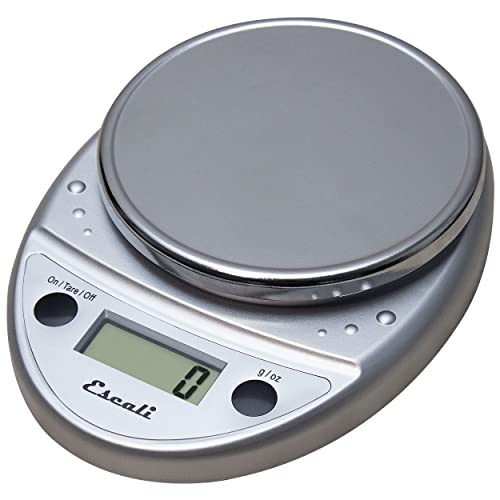
Escali Primo Digital Food Scale
The scale most often on a professional bench: it reads fast, tares instantly, and nothing about it is trying to also be a nutrition tracker.
Best for: weighing every ingredient, which is what makes scaling a recipe work
Check price on AmazonPan substitution comes down to one number: the ratio between the two pans' volumes. An 8 inch round pan holds 100.53 cubic inches to the rim; a 9 inch round holds 127.23, a ratio of 1.27, so a 9 inch round takes 27 percent more batter than an 8 inch round at the same depth. Multiply the recipe by that ratio to fill the new pan the same way, or accept a different fill level and a different bake time if you do not.
Every figure below is derived directly from pan geometry, the same arithmetic behind the pan substitution calculator. Batter depth changes along with capacity, and depth is what actually drives bake time, so a substitution that looks fine on paper can still need a different oven schedule. The chart below covers the pairs bakers ask about most; run any two pans through the calculator for an exact match.
Two pans that look similar at a glance can differ by more than either looks like it should, because volume scales with the square of a round pan's diameter, or the product of two dimensions for a rectangular one, not with a single length measurement. A pan that is only an inch wider across can hold noticeably more, which is the single most common reason a recipe written for one size disappoints in another without anyone changing a single ingredient.
How much batter does a substitute pan need?
A ratio above 1.00 means the new pan needs more batter than the original recipe makes. A ratio below 1.00 means it needs less, and pouring the full batch in will overfill it. Depth matters as much as the ratio itself, because a shallower layer bakes faster and a deeper one bakes slower and risks a raw center behind a set crust; the depth column exists precisely so a swap is not judged on capacity alone.
| From pan | To pan | Capacity ratio | Scale recipe by | New batter depth (in) | Fills to |
|---|---|---|---|---|---|
| 8 in round | 9 in round | 1.27 | 1.27x | 1.05 | 79% |
| 9 in round | 8 in round | 0.79 | 0.79x | 1.69 | 127% (overfills) |
| 8 in round | 10 in round | 1.56 | 1.56x | 0.85 | 64% |
| 8 in round | 8 in square | 1.27 | 1.27x | 1.05 | 79% |
| 8 in square | 8 in round | 0.79 | 0.79x | 1.70 | 127% (overfills) |
| 9 in round | 9 in square | 1.27 | 1.27x | 1.05 | 79% |
| 8 in round | 9x13 in rectangle | 2.33 | 2.33x | 0.57 | 43% |
| 9x13 in rectangle | 9 in round | 0.54 | 0.54x | 2.45 | 185% (overfills) |
| 9 in round | 9x5 in loaf | 0.97 | 0.97x | 1.88 | 103% |
| 9 in round | 9 in springform, 3 in deep | 1.50 | 1.50x | 1.33 | 67% |
| 9 in round | 12 cup bundt | 1.36 | 1.36x | Not derivable (fluted) | 74% |
| 10 in round | 12 in round | 1.44 | 1.44x | 0.93 | 69% |
| 6 in round | 8 in round | 1.78 | 1.78x | 0.75 | 56% |
| 9x13 in rectangle | Half sheet pan | 1.00 | 1.00x | 0.67 | 100% |
What capacity does each common pan actually hold?
These are the same batter figures used throughout this site's calculators, useful as a quick lookup before reaching for a calculator at all.
| Pan | Area (sq in) | Volume to rim (cu in) | Batter at two thirds full (cups) |
|---|---|---|---|
| 6 in round, 2 in deep | 28.27 | 56.55 | 2.61 |
| 8 in round, 2 in deep | 50.27 | 100.53 | 4.64 |
| 9 in round, 2 in deep | 63.62 | 127.23 | 5.87 |
| 10 in round, 2 in deep | 78.54 | 157.08 | 7.25 |
| 12 in round, 2 in deep | 113.10 | 226.19 | 10.44 |
| 14 in round, 2 in deep | 153.94 | 307.88 | 14.22 |
| 8 in square, 2 in deep | 64.00 | 128.00 | 5.91 |
| 9 in square, 2 in deep | 81.00 | 162.00 | 7.48 |
| 9x13 in rectangle, 2 in deep | 117.00 | 234.00 | 10.81 |
| Half sheet pan, 1 in deep | 234.00 | 234.00 | 10.81 |
| 9x5 in loaf, 2.75 in deep | 45.00 | 123.75 | 5.71 |
| 9 in springform, 3 in deep | 63.62 | 190.85 | 8.81 |
| 12 cup bundt | Not applicable (fluted) | 173.25 (published) | 8.00 |
Does changing shape change capacity even at the same nominal size?
Yes, and by a fixed amount that does not depend on how big the pan is, only on the shapes involved. These constants are worth remembering for the shapes used most often, because they let a baker judge a swap at a glance without reaching for a calculator, the same way knowing roughly what a dozen eggs weigh saves a trip to the scale for a rough estimate.
| Swap | Same size means | Capacity change | Why |
|---|---|---|---|
| Round to square | Same diameter as the square side, same depth | About 27 percent more | A circle covers about 78.5 percent of the square that contains it, so the square holds roughly the reciprocal more |
| Square to round | Same side as the round diameter, same depth | About 21 percent less | The reverse of the above; the round pan loses the area sitting in the square's corners |
| Round to hexagon | Same across-flats measurement, same depth | About 10 percent more | A regular hexagon covers a slightly larger fraction of its bounding circle than a round pan does |
| Round to heart | Same across measurement, same depth | About 14 percent more | The heart construction used on this site covers proportionally more of its width than a circle does |
| 9x13 rectangle to half sheet pan | Same footprint area, different depth | No change (0 percent) | 117 square inches at 2 inches deep and 234 square inches at 1 inch deep both hold 234 cubic inches |
| Two 8 in rounds to one 9x13 rectangle | Combined round batter against the rectangle | About 14 percent short | 9.28 cups from two 8 inch rounds against 10.81 cups for a 9x13, close but not an exact match |
What if neither of my two pans is on this chart?
Work out the capacity ratio directly rather than guessing from the diameters. Fill each pan with water from a measuring jug up to where the batter line would sit, roughly two thirds of the depth, and note the volume each one takes. Divide the target pan's volume by the original pan's volume, and that ratio is the same number this chart shows for the pairs above: the multiplier to scale a recipe, and the reciprocal of how full the original batch would leave the new pan.
This trick works for novelty pans, character molds, and any shape that does not reduce to a simple formula, including the same fluted bundt pans that cannot be measured by diameter alone. It takes about five minutes with a measuring jug and is more reliable than any published chart for a pan that is not a standard shape.
What this job actually needs
Escali Primo Digital Food Scale
$25.00The scale most often on a professional bench: it reads fast, tares instantly, and nothing about it is trying to also be a nutrition tracker.
Best for: weighing every ingredient, which is what makes scaling a recipe work
Check price on AmazonAmazon prices move often, so check before you buy.

Fat Daddio's Anodized Aluminum Round Cake Pans, 8 x 2 in, 2 Piece Set
$24.69Two matched 8 by 2 inch pans, which is exactly one two layer cake, in the anodized aluminum that bakes flatter than a dark nonstick pan because it reflects rather than absorbs.
Best for: the standard two layer 8 inch cake
Check price on AmazonAmazon prices move often, so check before you buy.
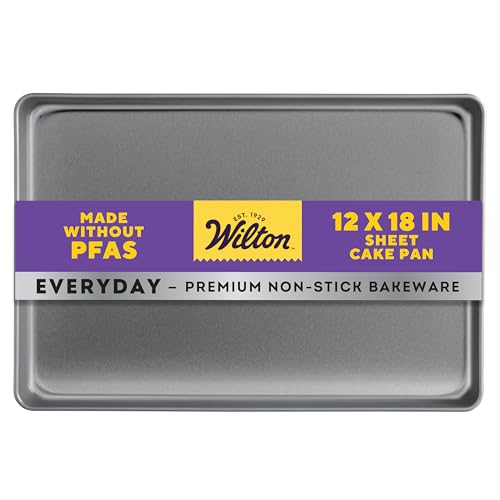
Wilton Aluminum Rectangular Sheet Cake Pan, 12 x 18 in
$17.97A full sheet in plain aluminum, which serves 108 at wedding portions and is the cheapest cake per head you can make.
Best for: feeding a crowd at the lowest cost
Check price on AmazonAmazon prices move often, so check before you buy.
Questions people ask
- Why does a 9 inch round need 27 percent more batter than an 8 inch round?
- Pan volume grows with the square of the diameter, not in a straight line with it. Going from an 8 inch to a 9 inch diameter is only a 12.5 percent increase in width, but that increase applies in both directions across the circle, so the area and the volume grow by about 27 percent instead. This is why a seemingly small jump in pan size at the store makes a bigger difference to a recipe than it looks like it should.
- Can I pour one 8 inch round recipe straight into a 9 inch pan without scaling it?
- Yes, and it will simply sit shallower than intended, at about 1.05 inches deep instead of 1.33, filling the 9 inch pan to roughly 79 percent instead of two thirds. That is a thinner, faster-baking layer rather than a failure, and it works fine for a single-layer cake. Scale the recipe by 1.27 only when the goal is the same proportions the original recipe was written for.
- Is it safe to pour a scaled-up batch into a pan that is technically too small?
- No. Once a pan is filled much past three quarters, batter climbs the wall as it rises and either spills into the oven or domes so heavily that a large portion has to be trimmed and thrown away. The 9x13-to-9-inch-round swap in the chart above is the extreme example: a full 9x13 batch would fill a 9 inch round to 185 percent, which means splitting the batter into two pans instead.
- Why does the bundt row not show a new batter depth?
- A bundt pan's interior is a fluted ring rather than a flat floor, so there is no single depth to measure the batter against the way there is in a round or square pan. The published cup capacity still allows a comparison of how much batter it holds against another pan, which is why the capacity ratio is shown even though the depth column is not. Use the recipe's own instructions for that pan when judging bake time.
- Does a darker or nonstick pan need a different amount of batter than a light aluminum one of the same size?
- No, batter quantity depends only on the pan's interior volume, which is unaffected by its coating or color. What changes with a dark or nonstick finish is how fast the outside browns, because it absorbs more heat than plain aluminum at the same oven temperature. That is a bake-time and crust consideration, not a capacity one, so the figures on this page apply regardless of the pan's finish.
Related pages
How this page was put together
Researched from pan geometry, published manufacturer capacities, published serving conventions and university extension guidance. Not hands-on testing, and not professional advice.
Figures are labelled as derived, published or trade convention. Where no honest figure exists, the page says so rather than filling the gap.