Quick answer
An 8 inch round pan takes 4.64 cups of batter filled two thirds full, out of 6.96 cups to the rim. A 9 x 13 pan takes 10.81 cups. Two thirds is the trade convention fill level, chosen to leave room for the batter to climb as it bakes without spilling over the wall.
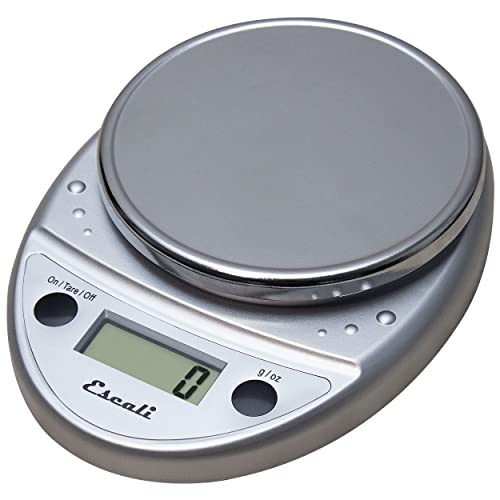
Escali Primo Digital Food Scale
The scale most often on a professional bench: it reads fast, tares instantly, and nothing about it is trying to also be a nutrition tracker.
Best for: weighing every ingredient, which is what makes scaling a recipe work
Check price on AmazonBatter volume on this chart always assumes the same fill level: two thirds of the pan's capacity to the rim. That is not a physical limit, it is how the trade fills a pan, because most cake batters expand somewhere between a quarter and a half again as the leavening works and steam forms, and two thirds leaves room for that without overflowing. An 8 inch round pan holds 6.96 cups to the rim and wants 4.64 cups of batter in it. A 9 x 13 pan holds 16.21 cups to the rim and wants 10.81 cups.
The tables below give the two thirds figure for every common pan, plus the batter depth that results, because depth is what actually drives bake time. For a size not shown, run it through the batter volume calculator. To scale a whole recipe rather than just check a pan's capacity, use the recipe scaling calculator, and see what that scaled bake time looks like on the bake time chart.
How much batter does an 8 inch round pan need?
Round pans are the most common shape in the kitchen, so this is the table most people come to first. Notice that the batter depth column reads identically down the whole table: every one of these pans is 2 inches deep, so a wider pan simply spreads the same depth of batter across more floor area rather than sitting any deeper.
| Pan | Capacity to rim (cups) | Batter at two thirds (cups) | Batter depth (in) |
|---|---|---|---|
| 6 in round | 3.92 | 2.61 | 1.33 |
| 8 in round | 6.96 | 4.64 | 1.33 |
| 9 in round | 8.81 | 5.87 | 1.33 |
| 10 in round | 10.88 | 7.25 | 1.33 |
| 12 in round | 15.67 | 10.44 | 1.33 |
| 14 in round | 21.33 | 14.22 | 1.33 |
How much batter for a 9x13 or sheet pan?
Sheet pans run shallower than layer pans, which shows up directly in a lower batter depth even at the same fill convention.
| Pan | Capacity to rim (cups) | Batter at two thirds (cups) | Batter depth (in) |
|---|---|---|---|
| 6 x 6 in square | 4.99 | 3.32 | 1.33 |
| 8 x 8 in square | 8.87 | 5.91 | 1.33 |
| 9 x 9 in square | 11.22 | 7.48 | 1.33 |
| 10 x 10 in square | 13.85 | 9.24 | 1.33 |
| 12 x 12 in square | 19.95 | 13.30 | 1.33 |
| 9 x 13 in rectangle | 16.21 | 10.81 | 1.33 |
| 11 x 15 in rectangle | 22.86 | 15.24 | 1.33 |
| 12 x 18 in rectangle | 29.92 | 19.95 | 1.33 |
| Quarter sheet, 9 x 13 in | 8.10 | 5.40 | 0.67 |
| Half sheet, 13 x 18 in | 16.21 | 10.81 | 0.67 |
How much batter for a heart, hexagon, loaf, tube or bundt pan?
A bundt pan is the exception on this page: its fluted interior has no flat floor, so there is no batter depth to report, only a volume.
Tube and bundt pans also behave differently in the oven because the centre tube conducts heat into the middle of the ring from the inside as well as the outside, which is part of why a bundt-shaped cake bakes faster relative to its total volume than a solid round of the same capacity. That inner surface does not show up in a batter volume figure at all, only in how the finished cake bakes, which is covered on the bake time chart.
| Pan | Capacity to rim (cups) | Batter at two thirds (cups) | Batter depth (in) |
|---|---|---|---|
| 8 in heart, across the widest point | 7.92 | 5.28 | 1.33 |
| 9 in hexagon, across flats | 9.72 | 6.48 | 1.33 |
| 9 in springform, 3 in deep | 13.22 | 8.81 | 2.00 |
| 9 x 5 in loaf | 8.57 | 5.71 | 1.83 |
| 10 in tube, 4 in deep | 18.28 | 12.19 | 2.67 |
| 12 cup bundt | 12.00 | 8.00 | Not established |
Does the fill level actually matter?
Yes, and an 8 inch round pan shows the range clearly. Filling higher buys a taller cake at real risk; filling lower is always safe but wastes the pan's capacity.
The two thirds figure is a starting point, not a fixed law, and different batters genuinely call for different fill levels. A whipped batter such as a genoise or a chiffon expands hard in the first several minutes of baking as the trapped air heats and the structure has not yet set, so those recipes are safer filled to half or a little past it. A dense, low-rise batter such as a pound cake or a mud cake barely climbs at all and can comfortably go to three quarters without any real risk of overflow. Cheesecake batter behaves differently again: it sets rather than rises, and a water bath limits how hot the outside edge gets anyway, so filling it close to the top is normal practice rather than a risk.
| Fill level | Batter (cups) | Batter depth (in) | What happens |
|---|---|---|---|
| Half full | 3.48 | 1.00 | A shallow layer, safe for any batter, good for a torte layer |
| Two thirds full | 4.64 | 1.33 | The working convention, room to rise without spilling |
| Three quarters full | 5.22 | 1.50 | Usually still safe, expect more doming on a light batter |
| Full to the rim | 6.96 | 2.00 | Will climb over the wall and the middle will not set in time |
What this job actually needs
Escali Primo Digital Food Scale
$25.00The scale most often on a professional bench: it reads fast, tares instantly, and nothing about it is trying to also be a nutrition tracker.
Best for: weighing every ingredient, which is what makes scaling a recipe work
Check price on AmazonAmazon prices move often, so check before you buy.

Fat Daddio's Anodized Aluminum Round Cake Pans, 8 x 2 in, 2 Piece Set
$24.69Two matched 8 by 2 inch pans, which is exactly one two layer cake, in the anodized aluminum that bakes flatter than a dark nonstick pan because it reflects rather than absorbs.
Best for: the standard two layer 8 inch cake
Check price on AmazonAmazon prices move often, so check before you buy.

Wilton Bake-Even Cake Strips, 2 Piece Set
$10.99Damp strips around the pan slow the outside so the middle catches up, which is what stops a dome forming and saves you levelling off the top and throwing it away.
Best for: flat layers with no trimming
Check price on AmazonAmazon prices move often, so check before you buy.
Questions people ask
- How much batter do I need for an 8 inch round cake pan?
- About 4.64 cups, filled to two thirds of the pan's 6.96 cup rim capacity. That fill level is a trade convention, not a hard rule, chosen because most cake batters rise by a quarter to a half again during baking, and two thirds leaves the room for that without spilling over the wall.
- How much batter do I need for a 9x13 pan?
- About 10.81 cups, filled to two thirds of the pan's 16.21 cup rim capacity. That sits the batter about 1.33 inches deep before it rises, the same starting depth as an 8 inch round pan at the same fill level, since both are conventionally 2 inches deep.
- Why fill a cake pan only two thirds full?
- Because cake batter expands as it bakes, typically by a quarter to a half again its raw volume, as leavening gas forms and water turns to steam. Filling to the rim leaves no room for that expansion, so the batter climbs over the wall, burns on the oven floor, and often leaves an underbaked centre under a dark crust. Two thirds is the convention that balances a full-looking cake against that risk.
- How many cupcakes come from an 8 inch cake batch?
- About 18 standard cupcakes, from the 4.64 cups of batter an 8 inch round pan takes at a two thirds fill, assuming a standard cupcake takes a quarter cup filled the same way. The same batch makes roughly 55 mini cupcakes or 9 jumbo cupcakes instead, depending on the liner size.
- How do I find the batter capacity of a pan that is not on this chart?
- Fill it with water from a measuring jug up to the rim and record the total; that is your rim capacity directly. Two thirds of that figure is your batter target. This works for novelty pans, character pans and anything else with no published capacity, and it is more reliable than any chart for a pan you actually own.
Related pages
How this page was put together
Researched from pan geometry, published manufacturer capacities, published serving conventions and university extension guidance. Not hands-on testing, and not professional advice.
Figures are labelled as derived, published or trade convention. Where no honest figure exists, the page says so rather than filling the gap.