Quick answer
Dark chocolate ganache runs from 1 part chocolate to 2 parts cream for a pourable glaze up to 2 parts chocolate to 1 part cream for a firm truffle centre. Milk chocolate needs roughly twice the chocolate of dark for the same firmness, and white chocolate needs about three times as much.

Callebaut No. 811 Finest Belgian Dark Chocolate Callets, 1 kg
The reference dark couverture at about 54 percent, in callets that melt evenly, which is what the published tempering ranges on this site assume.
Best for: ganache, tempering and drips
Check price on AmazonGanache ratios are always chocolate to cream by weight, never by volume, and that single detail is where most home ganache goes wrong. The ratio that sets a firm truffle centre in dark chocolate is 2 parts chocolate to 1 part cream. The same firmness in milk chocolate needs 3 to 1, and in white chocolate 4 to 1, because dark couverture carries the most cocoa solids and cocoa butter of the three, and those are what actually set a ganache as it cools. Milk chocolate replaces some of that with milk solids and sugar, and white chocolate has no cocoa solids at all, so both need proportionally more chocolate to reach the same firmness.
These ratios are published figures, taken from the ratios couverture manufacturers such as Callebaut, Valrhona and Guittard print on their own charts, not a house convention. What is convention is which firmness suits which job: a glaze wants to stay fluid, a drip wants to stop partway down the side, and a truffle centre wants to cut cleanly. The tables below give both the ratio and the gram quantities for a working batch. Scale any of them in the ganache calculator, and if the next step is tempering the chocolate itself rather than melting it into cream, see the chocolate tempering calculator.
What is the ganache ratio for dark, milk and white chocolate?
The five uses below run from thinnest to firmest for each chocolate type. Reading down any one type shows how much more cream a firmer set costs; reading across a use shows how much more chocolate a paler couverture needs for the same job.
| Chocolate type | Use | Ratio, chocolate:cream | Chocolate (g) | Cream (g) |
|---|---|---|---|---|
| Dark, 54 to 70 percent | Pourable glaze | 1:2 | 400 | 800 |
| Dark, 54 to 70 percent | Drip cake | 1:1 | 400 | 400 |
| Dark, 54 to 70 percent | Soft filling | 1:1 | 400 | 400 |
| Dark, 54 to 70 percent | Whipped frosting | 3:2 | 400 | 267 |
| Dark, 54 to 70 percent | Firm truffle centre | 2:1 | 400 | 200 |
| Milk, 31 to 40 percent | Pourable glaze | 2:2 | 400 | 400 |
| Milk, 31 to 40 percent | Drip cake | 2:1 | 400 | 200 |
| Milk, 31 to 40 percent | Soft filling | 2:1 | 400 | 200 |
| Milk, 31 to 40 percent | Whipped frosting | 5:2 | 400 | 160 |
| Milk, 31 to 40 percent | Firm truffle centre | 3:1 | 400 | 133 |
| White, 28 to 35 percent cocoa butter | Pourable glaze | 2.5:2 | 400 | 320 |
| White, 28 to 35 percent cocoa butter | Drip cake | 3:1 | 400 | 133 |
| White, 28 to 35 percent cocoa butter | Soft filling | 3:1 | 400 | 133 |
| White, 28 to 35 percent cocoa butter | Whipped frosting | 7:2 | 400 | 114 |
| White, 28 to 35 percent cocoa butter | Firm truffle centre | 4:1 | 400 | 100 |
How much cream do I need for a bigger batch of ganache?
Dark chocolate ganache at the whipped-frosting ratio, 3 parts chocolate to 2 parts cream, is one of the more common batch sizes to scale, so the table below runs it across a working range.
| Chocolate (g) | Cream (g) | Total ganache (g) |
|---|---|---|
| 200 | 133 | 333 |
| 300 | 200 | 500 |
| 400 | 267 | 667 |
| 500 | 333 | 833 |
| 600 | 400 | 1,000 |
| 700 | 467 | 1,167 |
| 800 | 533 | 1,333 |
| 900 | 600 | 1,500 |
| 1,000 | 667 | 1,667 |
Why does white chocolate need so much more chocolate than dark?
Cocoa butter and cocoa solids are what actually set a ganache as it cools, and the three chocolate types carry very different amounts of each. Dark couverture is mostly cocoa solids and cocoa butter. Milk chocolate replaces a good share of that with milk solids and sugar. White chocolate has no cocoa solids at all and sets purely on its cocoa butter content, which is why it needs roughly three times the chocolate of dark for the same firmness, and milk chocolate sits about halfway between the two.
Working temperature follows a similar pattern if you are tempering rather than melting into cream: white chocolate works at the lowest range of the three, dark at the highest, because dark chocolate simply has more cocoa butter to bring in and out of the right crystal form. Melt dark to 115 to 120 F, cool it to 82 to 84 F, and bring it back to 88 to 90 F to work; white chocolate runs about 10 degrees cooler at every stage. A specific manufacturer's own chart takes priority over these ranges when the two disagree, since recipes and conching differ between brands.
Ganache is always mixed by weight rather than volume in every ratio on this page. A cup of chopped chocolate and a cup of melted chocolate are not the same weight, and cream measured by volume varies with temperature and fat content, so a kitchen scale is not optional here the way it sometimes is elsewhere in baking.
Before this ganache leaves the kitchen
Ganache is a dairy product once the cream goes in, so treat it that way. A soft filling or whipped frosting made with fresh cream should be refrigerated if the finished cake will sit out for more than a couple of hours, and brought back toward room temperature before serving so it is not stiff and cold when cut. If you are baking for someone with a dairy or chocolate allergy, ask before you start, since cross contact happens at the mixing bowl rather than at the table.
What this job actually needs
Callebaut No. 811 Finest Belgian Dark Chocolate Callets, 1 kg
$44.85The reference dark couverture at about 54 percent, in callets that melt evenly, which is what the published tempering ranges on this site assume.
Best for: ganache, tempering and drips
Check price on AmazonAmazon prices move often, so check before you buy.
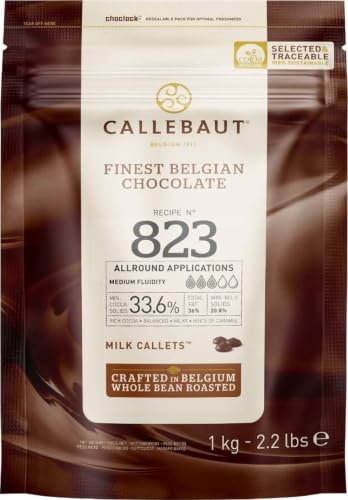
Callebaut No. 823 Finest Belgian Milk Chocolate Callets, 1 kg
$47.91Milk couverture needs roughly twice the chocolate of dark to reach the same ganache firmness, so buying a proper milk couverture rather than chips is what makes the ratio behave.
Best for: milk chocolate ganache and drips
Check price on AmazonAmazon prices move often, so check before you buy.

ThermoWorks Thermapen ONE Instant-Read Thermometer
$125.00A one second reading, which is what makes it usable for Swiss meringue where you are holding a whisk in the other hand and the syrup is still climbing.
Best for: Swiss and Italian meringue, and sugar work
Check price on AmazonAmazon prices move often, so check before you buy.
Questions people ask
- What is the ratio for a basic dark chocolate ganache?
- It depends on the job. A pourable glaze is 1 part dark chocolate to 2 parts cream by weight. A drip cake or a soft filling is 1 to 1. A whipped frosting that holds a piped shape is 3 parts chocolate to 2 parts cream, and a firm truffle centre is 2 to 1. All four are published ratios from couverture manufacturer charts, and the firmer the finish, the more chocolate relative to cream.
- Is milk chocolate ganache the same ratio as dark chocolate ganache?
- No, milk chocolate needs roughly twice the chocolate of dark for the same firmness. A firm truffle centre in dark chocolate is 2 parts chocolate to 1 part cream; in milk chocolate it is 3 to 1. Milk chocolate carries milk solids and sugar in place of some of the cocoa solids that set a ganache, so it takes more chocolate to reach the same set.
- Why does white chocolate ganache need so much chocolate?
- White chocolate has no cocoa solids at all, only cocoa butter, sugar and milk solids, so it sets purely on its cocoa butter content. That means it needs about three times the chocolate of dark for the same firmness: a firm white chocolate ganache runs 4 parts chocolate to 1 part cream, against 2 to 1 for dark chocolate doing the same job.
- Should ganache be measured by weight or by volume?
- Always by weight. A cup of chopped chocolate and a cup of melted chocolate are different weights, and cream measured by volume shifts with temperature and fat content. Every ratio on this page is chocolate to cream by weight, and following it by volume instead will produce a noticeably different, and often unpredictable, result.
- Does ganache need to be refrigerated?
- Once cream is mixed in, ganache is a dairy product and should be refrigerated if a finished cake will sit out for more than a couple of hours. Bring it back toward room temperature before serving so a filling or frosting is not stiff and cold when the cake is cut. A firm ganache made for truffle centres or panels holds up at room temperature longer than a soft, cream-heavy version.
Related pages
- High Altitude Baking Adjustment Chart by Elevation
- Frosting Quantity Chart: How Much Buttercream by Cake Size
- Stand Mixer Capacity Chart: Bowl Size by Batch
- Chocolate Tempering Temperature Chart by Type
- Tiered Cake Dowel Chart: Supports by Tier Size
- Cake Serving Chart: Servings by Pan Size and Shape
How this page was put together
Researched from pan geometry, published manufacturer capacities, published serving conventions and university extension guidance. Not hands-on testing, and not professional advice.
Figures are labelled as derived, published or trade convention. Where no honest figure exists, the page says so rather than filling the gap.