Quick answer
Chill baked layers at least 30 minutes, or 15 minutes in the freezer, since cold cake cuts cleanly while warm cake tears. Set an adjustable wire leveler to the height of your layer's shortest point, rest its feet flat on the counter, and pull the wire through in one steady motion rather than sawing.

Wilton Adjustable Cake Leveler, 12 x 6.25 in
A wire on an adjustable frame cuts a flatter torte than a knife does, because the wire follows the height you set instead of the angle of your wrist.
Best for: torting layers evenly
Check price on AmazonA cake domes because the edges of the batter, closest to the hot pan wall, set before the center does, so the middle keeps rising after the sides have stopped. Levelling removes that dome so the layers stack flat instead of rocking on a high point, and so the top of the finished cake reads level under a crumb coat instead of showing the dome through it. The tool matters less than most people think, but the principle behind it does: a wire on an adjustable frame follows the height you set, while a knife follows your wrist, and that is the entire reason a leveler produces a flatter cut without any more skill involved.
Before either tool touches the cake, chilling is the step that decides whether the cut is clean. A cake straight out of the oven, or even a couple of hours at room temperature, is soft enough that a wire or a blade compresses and tears it rather than slicing through, leaving a ragged, crumbly edge. Thirty to sixty minutes in the refrigerator, or about fifteen minutes in the freezer, firms the crumb enough that the same tool now cuts instead of drags. This is trade convention rather than a tested time, and a home refrigerator that runs colder or a layer that started out unusually moist will firm up faster or slower than the range suggests.
Levelling is normally the first step after a layer has cooled completely, ahead of torting it into thinner layers and long before a crumb coat goes anywhere near it. Getting it right here means less correcting later.
Why does a cake dome in the oven?
Heat reaches a cake pan mostly from the sides and the bottom, so the batter touching the pan wall sets into a fixed shape earlier than the batter in the middle. The center keeps expanding as its leavening finishes working, and with nowhere left to go but up, it rises past the height the edges already locked in. A hotter oven or a deeper fill exaggerates this, which is part of why the bake time and temperature calculator drops the oven temperature for large or deep pans in the first place, to give the center more time to catch up before the edges seal shut.
How do I level a cake step by step?
- Chill the baked, fully cooled layer in the refrigerator for 30 to 60 minutes, or in the freezer for about 15 minutes, until it feels firm rather than soft to a light fingertip press.
- Set the layer on a flat plate, a cake board, or a turntable, and measure its height at two or three points around the edge with a ruler held against the side to find the shortest point of the dome.
- Slide the crossbar of an adjustable wire leveler such as the Wilton Adjustable Cake Leveler, 12 x 6.25 in to that shortest height and lock it in place, so the wire sits perfectly parallel to the base the whole way across.
- Rest the leveler's feet flat on the counter or board on both sides of the cake, keeping full contact with the surface rather than letting either foot lift as you work.
- Pull the wire through the cake in one continuous, steady draw from one side to the other, without sawing back and forth, letting the wire do the cutting rather than pushing down through the crumb.
- Lift the dome off in one piece and set it aside, then run an offset spatula flat across the newly cut top to feel for any missed high spot before moving on to filling or frosting.
Without a dedicated leveler, a long serrated knife does the same job with more attention required. Rest one hand flat on top of the cake as a depth guide, hold the blade level with the counter, and saw in short strokes while rotating the cake a quarter turn between each stroke, so you are always cutting the same short arc rather than tracking the blade across the full diameter in one long pass. A Ateco 1445 Cake Tester poked into the trimmed dome is also a quick way to check whether the very center is a touch underbaked before you commit to cutting any further.
Wire leveler or knife: which cuts flatter?
Both can produce a usable cut, but they fail differently, and knowing which failure to expect changes how carefully you have to work with each one.
| Tool | What guides the cut | Typical result | Best for |
|---|---|---|---|
| Adjustable wire leveler | The height locked on the frame | A flat cut, parallel edge to edge, repeatable on every layer | Anyone levelling more than an occasional cake |
| Long serrated knife | Your eye and the steadiness of your wrist | Usable but can wave or tilt without deliberate small rotations | A kitchen without a dedicated leveler on hand |
What should I do with the trimmed dome?
The trimmings are real cake, not waste, and most decorators keep a bag of them in the freezer. Crumbled and bound with a little buttercream or ganache, they become cake pops or truffles. Layered into a trifle glass with pudding and fruit, they disappear entirely into a different dessert. The only thing worth avoiding is refreezing trimmings that have already thawed once, for the same reason any baked good loses texture on a second freeze and thaw.
What if the level comes out wrong?
| What you see | Usual cause | What to change |
|---|---|---|
| Layer cracks or crumbles as you cut | The cake is still warm | Chill 30 to 60 minutes longer before cutting |
| The cut comes out wavy or tilted | A sawing motion instead of one steady pull, or the leveler’s feet lifted off the counter | Keep the feet flat on the counter and pull the wire through in one motion |
| The wire or knife drags and tears the crumb | A dull wire or blade, or moving too slowly through the cake | Replace the wire, or use light, constant pressure instead of pushing hard |
| The top is still domed after cutting | The leveler height was set to the tallest point instead of the shortest | Reset the height to the layer’s shortest point and take a second, thin pass |
What this job actually needs
Wilton Adjustable Cake Leveler, 12 x 6.25 in
$19.49A wire on an adjustable frame cuts a flatter torte than a knife does, because the wire follows the height you set instead of the angle of your wrist.
Best for: torting layers evenly
Check price on AmazonAmazon prices move often, so check before you buy.
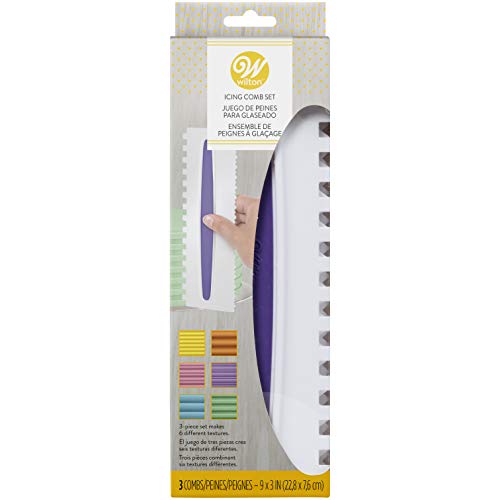
Wilton Cake Icing Smoother and Adjustable Cake Leveler Set
$37.55Pairs the two tools that decide whether a cake looks straight: a leveller that cuts a flat top and a smoother tall enough to true the side against it.
Best for: getting a cake genuinely square before decorating
Check price on AmazonAmazon prices move often, so check before you buy.

Ateco 1445 Cake Tester
$3.95A thin wire leaves a hole you cannot see, unlike a skewer, which matters on the top of a cake you are about to glaze rather than frost.
Best for: testing doneness without marking the top
Check price on AmazonAmazon prices move often, so check before you buy.
Questions people ask
- How long should I chill a cake before leveling it?
- At least 30 to 60 minutes in the refrigerator, or about 15 minutes in the freezer, until the layer feels firm rather than soft under a light fingertip press. This is a trade convention rather than a tested time, since ovens and refrigerators vary, but cold cake compresses cleanly under a wire or blade where warm cake tears and crumbles instead.
- Can I level a cake without an adjustable leveler?
- Yes, a long serrated knife works, though it takes more care. Rest one hand flat on top of the cake as a height guide, keep the blade level with the counter, and saw in short strokes while rotating the cake a quarter turn between each one. Sawing in short arcs and rotating often produces a flatter result than trying to draw the knife across the whole diameter in one long stroke.
- What do I do with the cake scraps after leveling?
- Save them rather than discard them. Crumbled trimmings bound with a little buttercream or ganache become cake pops or truffles, and they layer well into a trifle with pudding and fruit. Keep them frozen if not using them the same day, but avoid refreezing trimmings that have already thawed once, since the texture suffers on a second freeze and thaw.
- Should I level every layer or just the top one?
- Level any layer that domes, not only the one on top. An unlevelled middle layer tilts everything stacked above it, which shows up as a lean in the finished cake that no amount of frosting can hide. A perfectly flat layer straight from the pan, which does happen with some recipes and pans, needs no levelling at all.
- Does a cake need to cool completely before leveling?
- Yes, fully cool and then chilled. A warm cake is still soft and steaming internally, so a wire or blade compresses it instead of cutting cleanly, and cutting into a cake before it has finished releasing heat traps moisture inside that would otherwise escape. Cool it to room temperature first, then chill it before levelling for the cleanest cut.
Related pages
How this page was put together
Researched from pan geometry, published manufacturer capacities, published serving conventions and university extension guidance. Not hands-on testing, and not professional advice.
Figures are labelled as derived, published or trade convention. Where no honest figure exists, the page says so rather than filling the gap.