Quick answer
Past about 12 inches across, a cake's outside sets long before the middle does. Bake-even strips and a heating core both slow the edge and speed the middle, but each changes the timing. Drop the oven to 325 F once the shortest span across the pan reaches 10 inches. These are computed estimates from the pan geometry, never tested times.

Wilton Bake-Even Cake Pan Strips, 6 Piece Set
Six strips covers a whole tiered bake at once, including the large pans where uneven baking actually costs you cake rather than a few millimetres.
Best for: baking several tiers in one session
Check price on AmazonEvery cake bakes from the outside in, since heat travels from the pan wall and floor toward the center. That works fine at ordinary sizes because the distance from the wall to the middle is short enough for the whole cake to finish at roughly the same time. Past about 12 inches across, that distance gets long enough that the outside of the cake sets, browns and starts to dry out well before the heat has finished reaching the middle, which is why a large tier baked exactly like a small one so often comes out with a cracked, domed top and a center that needed another fifteen minutes.
Two tools fix the two halves of that problem. Bake-even strips wrapped around the outside of the pan slow the wall down, so the edge does not finish so far ahead of the middle. A heating core set into the center of the batter does the opposite job, conducting heat inward from the middle as well as from the wall, which shortens the distance the center has to wait. Both genuinely change the bake time, and the figures below, run through the same computed model behind the bake time calculator, are starting points to check against, not fixed answers.
How long does a large cake tier take to bake?
The table below runs every common large round size at 2 inches deep, filled two thirds, through the site's bake time model. Every one of these sizes crosses the 10 inch span threshold, so all of them bake at 325 F under this site's convention.
| Pan | Batter depth (in) | Oven temp (F) | Start checking (min) | Expected range (min) |
|---|---|---|---|---|
| 10 in round | 1.33 | 325 | 35 | 35 to 55 |
| 12 in round | 1.33 | 325 | 45 | 45 to 65 |
| 14 in round | 1.33 | 325 | 50 | 50 to 75 |
| 16 in round | 1.33 | 325 | 55 | 55 to 85 |
| 18 in round | 1.33 | 325 | 65 | 65 to 95 |
Does a 3 inch deep large tier take much longer?
Yes, and by a wide margin, because a 3 inch pan filled two thirds carries a full extra inch of batter depth compared with the standard 2 inch layer pan, and depth is the strongest single driver of bake time in the model.
| Pan | Batter depth (in) | Oven temp (F) | Start checking (min) | Expected range (min) |
|---|---|---|---|---|
| 12 in round, 3 in deep | 2.00 | 325 | 75 | 75 to 110 |
| 14 in round, 3 in deep | 2.00 | 325 | 85 | 85 to 125 |
| 16 in round, 3 in deep | 2.00 | 325 | 95 | 95 to 140 |
What is a heating core and how much do bake-even strips help?
A heating core is a metal tube or a large flower nail set upright in the center of the pan before the batter goes in, so it sits buried in the middle of the cake as it bakes. Because metal conducts heat far faster than raw batter does, the core carries heat inward from the center at the same time the pan wall is carrying it in from the outside, which shortens the distance the slowest part of the cake has to wait to finish. It is a genuinely different fix from a bake-even strip, and the two are often used together on anything past about 12 inches.
A bake-even strip works the opposite side of the same problem: a damp strip wrapped around the outside of the pan slows the wall down instead of speeding the middle up, so the two ends of the bake meet closer to the same moment. The trade-off is a few extra minutes on the total bake time, which is a fair exchange for a flat top that needs no leveling and an edge that has not dried out by the time the center finishes.
How do you actually know when a large cake is done?
The clock is a starting point on any pan, and it matters even more on a large one, where the computed range above is widest. Four cues decide the moment, in order of how easy they are to check without cutting into the cake:
- The middle springs back when pressed lightly, leaving no dent behind.
- A skewer pushed into the center comes out with a few moist crumbs clinging to it, not wet batter.
- The edges have pulled very slightly away from the pan wall all the way around.
- The surface has stopped hissing, which is the sound of water still boiling off the top.
On a large tier specifically, check the middle at the low end of the computed range and again every five minutes after that, since the gap between an underbaked center and an overbaked edge is real and worth catching early rather than guessing at the high end of the range and hoping.
What goes wrong baking a large cake tier?
| Problem | Likely cause | Fix |
|---|---|---|
| Cake domes heavily in the middle | Oven too hot for the pan size, or no bake-even strips used | Confirm the oven is at the 325 F convention for a 10 inch span or wider, and wrap the pan with bake-even strips before it goes in |
| Edges are dry while the center is still wet | Pan too large for heat to reach the middle in time | Add a heating core to the batter before baking, and check doneness with the cues above rather than the clock |
| Outside sets and cracks before the middle finishes | The classic failure past about 12 inches, with no help for either end of the bake | Use a bake-even strip and a heating core together, and plan for the bake to run toward the high end of the computed range |
| Middle sinks after cooling | Pulled early because the clock said it should be done | Trust the doneness cues over the estimate: a springy middle, a skewer with moist crumbs, and edges just pulling from the pan wall |
| Cake browns unevenly across a wide surface | Oven has hot spots, more noticeable the larger the pan is | Rotate the pan once partway through baking, and check the oven with a separate thermometer such as Taylor Large 2.5 Inch Dial Oven Thermometer |
What this job actually needs
Wilton Bake-Even Cake Pan Strips, 6 Piece Set
$24.92Six strips covers a whole tiered bake at once, including the large pans where uneven baking actually costs you cake rather than a few millimetres.
Best for: baking several tiers in one session
Check price on AmazonAmazon prices move often, so check before you buy.
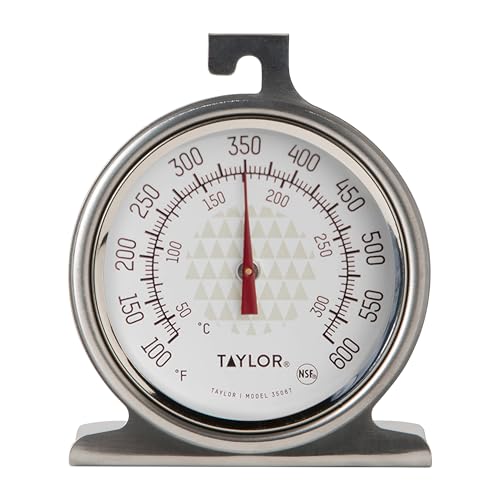
Taylor Large 2.5 Inch Dial Oven Thermometer
$8.28Home ovens routinely run 25 F or more off their dial, which is the real reason a bake time chart never matches your oven, and this is the cheapest way to find out by how much.
Best for: finding out what your oven actually does
Check price on AmazonAmazon prices move often, so check before you buy.

Fat Daddio's Anodized Aluminum Round Cake Pan, 12 x 2 in
$21.99A 12 inch base tier serves 56 at wedding portions on its own, and anodized aluminum is what keeps the outside from setting far ahead of the middle at that span.
Best for: the base tier of a three tier cake
Check price on AmazonAmazon prices move often, so check before you buy.
Questions people ask
- Why does a large cake bake unevenly?
- Because heat has to travel from the pan wall and floor inward, and past about 12 inches across, the outside of the cake has fully set before that heat reaches the middle. The result is a cake with a dry, overbaked edge and a center that is still wet, or a dome that cracks as the middle finally catches up.
- How long does a 14 inch cake take to bake?
- At 2 inches deep and filled two thirds, start checking around 50 minutes and expect a total bake of about 50 to 75 minutes at 325 F. That is a computed estimate from the pan's geometry, not a tested time, and a bake-even strip or a heating core will genuinely change it, usually adding a few minutes while flattening the top.
- What does a heating core do?
- A heating core is a metal tube or cone set into the center of the batter before baking, which conducts heat inward from the middle as well as from the pan wall. That shortens the distance heat has to travel to the center of a very wide cake, which is what lets a large tier finish before its edges overbake.
- Do bake-even strips actually make a difference on a large pan?
- Yes, and the effect is more noticeable the larger the pan. A damp strip wrapped around the outside slows the wall down, which keeps the edge from setting so far ahead of the middle that a dome or a crack forms. It typically adds a few minutes to the bake, which is a fair trade for a flat top that needs no leveling.
- How do I know when a large cake is actually done?
- Trust the doneness cues over the clock: the middle should spring back without leaving a dent, a skewer in the center should come out with moist crumbs rather than wet batter, the edges should have pulled slightly away from the pan wall, and the surface should have stopped hissing, which is the sound of water still boiling off.
Related pages
How this page was put together
Researched from pan geometry, published manufacturer capacities, published serving conventions and university extension guidance. Not hands-on testing, and not professional advice.
Figures are labelled as derived, published or trade convention. Where no honest figure exists, the page says so rather than filling the gap.