Quick answer
For milk chocolate ganache used as a whipped frosting, holds a piped shape once beaten, use 5:2 chocolate to cream by weight. With 400 g of milk chocolate that is 160 g of cream, giving 560 g of ganache. Weigh it, because ganache ratios by volume do not work.

Callebaut No. 811 Finest Belgian Dark Chocolate Callets, 1 kg
The reference dark couverture at about 54 percent, in callets that melt evenly, which is what the published tempering ranges on this site assume.
Best for: ganache, tempering and drips
Check price on AmazonThe ratio is 5:2 chocolate to cream, by weight. For 400 g of milk chocolate that means 160 g of cream.
Milk chocolate carries milk solids and sugar in place of cocoa solids, so it needs roughly twice the chocolate of dark for the same set.
Scale it to any quantity in the ganache calculator, or compare every type and use on the ganache ratio chart.
What is the milk chocolate ganache ratio for a frosting?
| Chocolate (g) | Cream (g) | Total (g) | Roughly covers |
|---|---|---|---|
| 200 | 80 | 280 | A 6 inch cake |
| 300 | 120 | 420 | A 6 inch cake |
| 400 | 160 | 560 | An 8 inch cake |
| 600 | 240 | 840 | A 10 inch cake |
| 800 | 320 | 1120 | A 10 inch cake |
| 1000 | 400 | 1400 | A 12 inch cake or a small tier |
Why does the chocolate type change the ratio?
Because ganache sets on cocoa butter and cocoa solids, and the three types carry very different amounts of both. Dark chocolate is mostly cocoa; milk chocolate replaces much of that with milk solids and sugar; white chocolate has no cocoa solids at all and sets purely on its cocoa butter.
Substitute white for dark at the same ratio and you get a sauce rather than a ganache, which is the commonest way this goes wrong.
| Chocolate type | Chocolate to cream | For 400 g chocolate | Why |
|---|---|---|---|
| Dark (54 to 70 percent) | 3:2 | 267 g cream | Dark couverture sets hardest for a given weight of cream because it carries the most cocoa solids and cocoa butter. |
| Milk (31 to 40 percent) | 5:2 | 160 g cream | Milk chocolate carries milk solids and sugar in place of cocoa solids, so it needs roughly twice the chocolate of dark for the same set. |
| White (28 to 35 percent cocoa butter) | 7:2 | 114 g cream | White chocolate has no cocoa solids at all and sets only on its cocoa butter, so it needs about three times the chocolate of dark. |
What else does this ratio do?
Changing the ratio changes the job, not the quality. The same chocolate makes all five of these.
| Use | Chocolate to cream | For 400 g chocolate | Texture when set |
|---|---|---|---|
| Pourable glaze, still fluid when it sets | 2:2 | 400 g cream | Pourable, stays glossy |
| Drip cake, thick enough to stop partway down the side | 2:1 | 200 g cream | Thick, stops partway down |
| Soft filling, spoonable at room temperature | 2:1 | 200 g cream | Spoonable at room temperature |
| Whipped frosting, holds a piped shape once beaten | 5:2 | 160 g cream | Holds a piped shape once beaten |
| Truffle centres and firm panels, cuts cleanly | 3:1 | 133 g cream | Firm enough to cut cleanly |
Before this cake leaves the kitchen
A few things worth knowing before this cake leaves the kitchen. Cream cheese frostings and anything with whipped cream need refrigeration, and plain buttercream softens in a warm room long before it is unsafe, which is a structural problem rather than a health one. Royal icing made with raw egg white, and mousses set with raw egg, are worth swapping for pasteurised egg white or meringue powder when you are baking for children, older guests or anyone pregnant. If you are baking for other people, ask about allergies before you start rather than after, because cross contact happens at the mixing bowl and not at the table. And if you are selling rather than giving cakes away, that is governed by your state cottage food law, which varies a great deal and is worth reading once properly.
What this job actually needs
Callebaut No. 811 Finest Belgian Dark Chocolate Callets, 1 kg
$44.85The reference dark couverture at about 54 percent, in callets that melt evenly, which is what the published tempering ranges on this site assume.
Best for: ganache, tempering and drips
Check price on AmazonAmazon prices move often, so check before you buy.
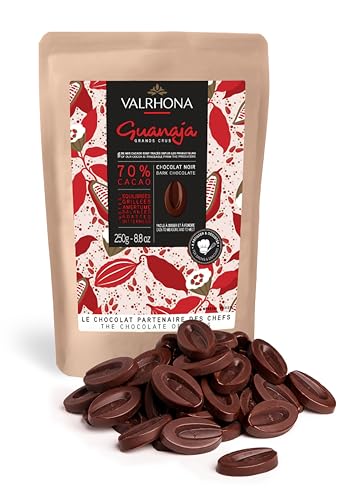
Valrhona Guanaja 70 Percent Dark Chocolate Feves
$43.99At 70 percent it sets harder for the same cream than a 54 percent does, so a ganache recipe written for Callebaut 811 needs more cream if you swap to this.
Best for: firm ganache and a more bitter finish
Check price on AmazonAmazon prices move often, so check before you buy.

Etekcity 0.1 g Food Kitchen Scale with Bowl
$18.99A tenth of a gram matters for baking powder and salt, where a 1 gram scale rounds an ingredient that is measured in single grams.
Best for: weighing leavening and salt accurately
Check price on AmazonAmazon prices move often, so check before you buy.
Questions people ask
- Can I measure ganache in cups instead of weighing it?
- Not reliably. Chocolate callets pack differently depending on their shape and how you pour them, so a cup of chocolate can vary by a third in weight between two fills of the same jug. Ganache is one of the places where the ratio has to be right, since being twenty percent out turns a frosting into something else entirely. Weigh both sides.
- Why did my ganache split, and can I fix it?
- Splitting usually means the cream was too hot or the mix was stirred too vigorously while the emulsion was still forming. It is nearly always fixable: add a spoonful of warm milk and stir from the centre outward in small circles, or blend it briefly with a stick blender kept below the surface so it does not draw in air.
- How long can ganache sit out?
- A dark ganache at a firm ratio is stable at cool room temperature for a day or so, and shops routinely keep it out. Ratios with more cream, and milk and white ganaches generally, are far less stable and are better refrigerated. If the cake carrying it also has cream cheese or whipped cream in it, refrigerate regardless of what the ganache would tolerate on its own.
Related pages
How this page was put together
Researched from pan geometry, published manufacturer capacities, published serving conventions and university extension guidance. Not hands-on testing, and not professional advice.
Figures are labelled as derived, published or trade convention. Where no honest figure exists, the page says so rather than filling the gap.