Quick answer
Multiply every ingredient by 1.27 to take a recipe written for an 8 inch round, 2 inch deep pan and fill a 8 inch square, 2 in deep pan instead. That takes the batter from 4.64 cups to 5.91 cups, and the bake time moves with the new batter depth.
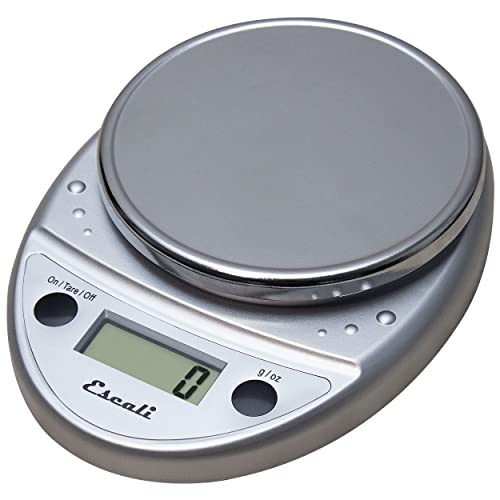
Escali Primo Digital Food Scale
The scale most often on a professional bench: it reads fast, tares instantly, and nothing about it is trying to also be a nutrition tracker.
Best for: weighing every ingredient, which is what makes scaling a recipe work
Check price on AmazonThe scale factor is 1.27. An 8 inch round, 2 inch deep pan takes 4.64 cups of batter at a two thirds fill; a 8 inch square, 2 in deep pan takes 5.91 cups. Divide the second by the first and you have your multiplier.
Weigh rather than measure once the factor stops being a round number, because 1.27 times three quarters of a cup is not a measurement anybody can make accurately with a cup.
Scale between any two pans in the recipe scaling calculator.
What is the scale factor from an 8 inch round to a 8 inch square, 2 in deep pan?
| Ingredient | For an 8 inch round | For a 8 inch square, 2 in deep | Note |
|---|---|---|---|
| Flour | 240 g | 305 g | Scales cleanly |
| Sugar | 300 g | 381 g | Scales cleanly |
| Butter | 170 g | 216 g | Scales cleanly |
| Egg | 110 g (about 2 large) | 140 g | Weigh beaten egg rather than counting whole ones |
| Milk | 180 g | 229 g | Scales cleanly |
| Baking powder | 6 g | 7.6 g | Scale slightly under on a large increase, see below |
| Salt | 3 g | 3.8 g | Scales cleanly |
| Batter total (cups) | 4.64 | 5.91 | Two thirds fill, trade convention |
Which ingredients do not scale cleanly?
Most do. Three do not, and they are the reason a doubled recipe sometimes fails when every number was multiplied correctly.
| Ingredient | Scale it linearly? | What to do instead |
|---|---|---|
| Chemical leavening | Not quite | A larger, deeper cake needs proportionally slightly less, because the batter has longer in the oven and more time for the gas to work. On a factor above about 2, scale leavening at roughly 90 percent of linear. |
| Eggs | By weight, yes | Whole eggs come in discrete sizes. Weigh beaten egg to hit the scaled number rather than rounding to the nearest egg, which on a small recipe is a large error. |
| Salt and strong flavourings | Yes, but taste | Extracts and spices scale linearly on paper and often taste stronger than expected in a large batch. Scale them, then taste the batter. |
| Pan preparation | No | Greasing and lining scale with surface area, not volume, so a much larger pan needs proportionally less than the volume factor suggests. |
What happens to the bake time and the servings?
| 8 inch round, 2 in deep | 8 inch square, 2 in deep | Basis | |
|---|---|---|---|
| Batter (cups) | 4.64 | 5.91 | Two thirds fill |
| Batter depth (in) | 1.33 | 1.33 | Derived |
| Oven temperature (F) | 350 | 350 | Trade convention |
| Estimated time (min) | 25 to 40 | 30 to 45 | Computed estimate |
| Party servings | 16 | 21 | Trade convention portion |
Before this cake leaves the kitchen
A few things worth knowing before this cake leaves the kitchen. Cream cheese frostings and anything with whipped cream need refrigeration, and plain buttercream softens in a warm room long before it is unsafe, which is a structural problem rather than a health one. Royal icing made with raw egg white, and mousses set with raw egg, are worth swapping for pasteurised egg white or meringue powder when you are baking for children, older guests or anyone pregnant. If you are baking for other people, ask about allergies before you start rather than after, because cross contact happens at the mixing bowl and not at the table. And if you are selling rather than giving cakes away, that is governed by your state cottage food law, which varies a great deal and is worth reading once properly.
What this job actually needs
Escali Primo Digital Food Scale
$25.00The scale most often on a professional bench: it reads fast, tares instantly, and nothing about it is trying to also be a nutrition tracker.
Best for: weighing every ingredient, which is what makes scaling a recipe work
Check price on AmazonAmazon prices move often, so check before you buy.

KitchenAid Artisan 5 Quart Tilt-Head Stand Mixer (KSM150PS)
$399.99The default decorating mixer: 10 speeds down to a stir that folds rather than throws, a 5 quart bowl rated for 9 cups of flour, and the tilt head that makes scraping a buttercream bowl quick.
Best for: the buy-once home mixer for cakes and buttercream
Check price on AmazonAmazon prices move often, so check before you buy.

OXO Good Grips 11 Pound Stainless Steel Food Scale with Pull-Out Display
$61.19The pull-out display is the fix for the one real flaw in kitchen scales, which is that a large mixing bowl hides the numbers.
Best for: weighing into large bowls
Check price on AmazonAmazon prices move often, so check before you buy.
Questions people ask
- Can I just double an 8 inch recipe instead of scaling by 1.27?
- You can, and then you have too much batter for a 8 inch square, 2 in deep pan. Doubling gives 9.3 cups against the 5.91 cups this pan wants at a two thirds fill. Bake the extra as cupcakes rather than overfilling the pan.
- Does scaling a recipe change how it tastes?
- It can, in two ways worth knowing. A larger, deeper cake spends longer in the oven, so it develops more crust and can dry at the edges before the middle sets. And chemical leavening scaled linearly sometimes reads as a slight soapy note in a big batch, which is why the convention is to scale it a little under on large factors.
- Is it better to scale up or bake two batches?
- Two batches, if your mixer bowl cannot comfortably hold the scaled volume. 5.91 cups of batter needs a bowl with real headroom, and a bowl filled to the brim cannot be mixed properly, which gives you streaks of unmixed flour. Mixing two batches and combining them by hand is what a bakery would do and costs nothing but time.
Related pages
- Scaling an 8 Inch Cake Recipe to a 9 inch round, 2 in deep Pan
- Scaling an 8 Inch Cake Recipe to a 8 inch round, 3 in deep Pan
- Scaling an 8 Inch Cake Recipe to a 9 inch springform, 3 in deep Pan
- Scaling an 8 Inch Cake Recipe to a 6 inch round, 3 in deep Pan
- Scaling an 8 Inch Cake Recipe to a 9 x 13 inch rectangle, 2 in deep Pan
- Scaling an 8 Inch Cake Recipe to a 6 inch round, 2 in deep Pan
How this page was put together
Researched from pan geometry, published manufacturer capacities, published serving conventions and university extension guidance. Not hands-on testing, and not professional advice.
Figures are labelled as derived, published or trade convention. Where no honest figure exists, the page says so rather than filling the gap.