Quick answer
The scaling factor is the target pan's batter volume divided by the original pan's, for example about 1.56 going from an 8 inch round to a 10 inch round. Multiply every ingredient by that factor, weigh rather than measure once it is not a round number, and weigh beaten egg by weight instead of counting whole eggs.
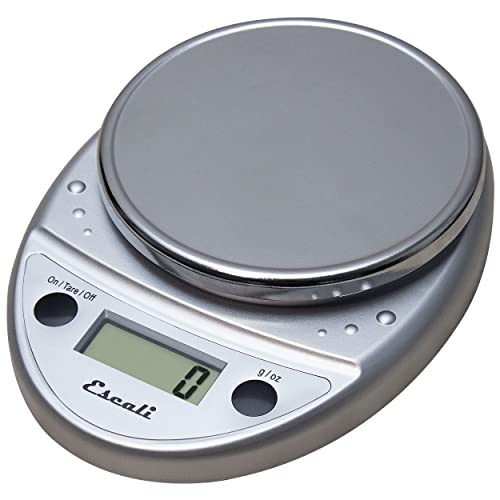
Escali Primo Digital Food Scale
The scale most often on a professional bench: it reads fast, tares instantly, and nothing about it is trying to also be a nutrition tracker.
Best for: weighing every ingredient, which is what makes scaling a recipe work
Check price on AmazonScaling a cake recipe is a volume ratio, not a guess. The factor is always the target pan's batter capacity divided by the original pan's, an exact figure derived from the two pans' geometry rather than a rule of thumb. Going from an 8 inch round to a 10 inch round is a factor of about 1.56; going from the same 8 inch round down to a 6 inch round is about 0.56. Multiply every ingredient in the original recipe by that number and the batter fills the new pan to the same working level the original recipe was written for.
Two things do not scale in a straight line, and they are worth knowing before the batter goes in the oven. Chemical leavening, baking powder and baking soda, scales slightly under a straight multiplication once the factor passes about two, because a proportionally bigger charge of gas in a much larger batch is more likely to overwhelm the crumb structure before it sets. And eggs should be weighed rather than counted once a factor lands on an awkward number, since a recipe scaled by 1.27 genuinely needs something like two and a half eggs, and there is no way to crack half an egg accurately. Run any two pans through the recipe scaling calculator, or compare capacities directly with the pan substitution calculator.
What is the scaling factor between common pan sizes?
Every factor below is the target pan's batter volume divided by the original's, computed from the pans' actual dimensions rather than looked up from a chart written for different pans.
| From | To | Scale factor |
|---|---|---|
| 8 in round | 6 in round | 0.56 |
| 8 in round | 9 in round | 1.27 |
| 8 in round | 10 in round | 1.56 |
| 8 in round | 12 in round | 2.25 |
| 9 in round | 9 x 13 in rectangle | 1.84 |
| 8 in round | half sheet, 13 x 18 in | 2.33 |
| 8 in round, 1 pan | 8 in round, 2 pans | 2.00 |
How do you scale a cake recipe step by step?
- Find the batter volume of the pan the recipe was written for and the pan you actually want to bake in, from a batter volume chart or calculator, then divide the second by the first to get the raw scale factor.
- Multiply every ingredient by that factor, in weight rather than volume wherever the original recipe allows, since scaling a cup measurement compounds inaccurately across a whole recipe.
- Round the flour, sugar and fat quantities to the nearest gram or a workable fraction, since a kitchen scale reads to the gram but a factor like 1.56 rarely lands on one.
- Crack the original recipe's number of eggs times the scale factor, whisk them together in one bowl, weigh the total, and pour out only the proportional weight rather than trying to divide a whole egg by eye.
- Taper chemical leavening back slightly once the factor passes about two, holding baking powder or baking soda to roughly a tenth less than the straight multiplication would call for.
- Check the batter against the new pan's two-thirds fill line before pouring, since a scaling error shows up here, as a pan that is obviously too full or too empty, well before it shows up in the oven.
- Expect the bake time to move with the new batter depth, not just the new pan's width, and start checking at the low end of a fresh computed estimate for the new pan rather than reusing the original recipe's time.
- Bake a small test batch first if the factor is unusual, such as scaling into an odd number of pans, since a test bake is far cheaper than a failed tier the night before an event.
Why does leavening scale differently than everything else?
Chemical leavening works by releasing gas into batter that has not yet set, and the crumb structure has to hold that gas in as small, even bubbles rather than letting it force its way out or collapse the structure before baking finishes. In a small batch that balance is forgiving; in a much larger batch scaled at the full straight multiplication, the same proportional gas release happens inside a bigger, slower-setting mass of batter, which gives the bubbles more time and more room to over-expand, coalesce, or blow out the surface before the structure is ready to hold them.
The usual practice is to hold baking powder or baking soda back by roughly a tenth once the scale factor passes about two, rather than multiplying it at the same rate as flour and sugar. This is a working adjustment based on how the trade handles large batches, not a fixed formula, and it is worth nudging on the next bake if a scaled cake still domes hard or has an uneven crumb despite the adjustment.
Why weigh eggs instead of counting them?
Because whole eggs are not a fine enough unit for most scale factors. A recipe that calls for two eggs, scaled by a factor of 1.27, genuinely needs about 2.5 eggs, and there is no accurate way to crack half an egg by eye. Whisking the needed whole eggs together in one bowl first, weighing the total, and then measuring out only the proportional weight the scale factor calls for solves this cleanly, and it works for any factor rather than only the ones that happen to land on a whole number.
A useful working figure is that a large egg without its shell weighs close to 50 grams, split roughly 30 grams of white to 20 grams of yolk, though real eggs vary enough that weighing the actual eggs you cracked beats assuming that figure. This matters most on a downscale, where counting a fraction of an egg by eye is genuinely difficult, and least on an upscale by a round number, where whole eggs still divide cleanly.
What goes wrong when scaling a cake recipe?
| Problem | Likely cause | Fix |
|---|---|---|
| Batter overflows the new pan | Scale factor calculated in the wrong direction, or applied against the wrong pan's capacity | Recheck which pan is the original and which is the target, and confirm the batter against the two-thirds fill line before pouring |
| Cake tastes eggy or dense after scaling up | Egg quantity rounded up to a whole extra egg rather than weighed proportionally | Whisk all the needed eggs together first and weigh out only the exact scaled amount |
| Cake domes hard or overflows despite a correct pour | Leavening scaled at the full straight factor on a large batch | Taper baking powder or baking soda by roughly a tenth once the scale factor passes about two |
| Texture turns gummy or dense in the bigger batch | Batter measured by volume instead of weight after scaling | Weigh flour, sugar and fat rather than scaling cup measurements, since volume scaling compounds small errors across every ingredient |
| Two pans of the same scaled batter bake unevenly | Batter split unevenly by eye between the pans | Weigh the total batter and divide it by pan count on a scale, rather than judging an equal fill by looking at the pans |
What this job actually needs
Escali Primo Digital Food Scale
$25.00The scale most often on a professional bench: it reads fast, tares instantly, and nothing about it is trying to also be a nutrition tracker.
Best for: weighing every ingredient, which is what makes scaling a recipe work
Check price on AmazonAmazon prices move often, so check before you buy.

Etekcity 0.1 g Food Kitchen Scale with Bowl
$18.99A tenth of a gram matters for baking powder and salt, where a 1 gram scale rounds an ingredient that is measured in single grams.
Best for: weighing leavening and salt accurately
Check price on AmazonAmazon prices move often, so check before you buy.

OXO Good Grips 11 Pound Stainless Steel Food Scale with Pull-Out Display
$61.19The pull-out display is the fix for the one real flaw in kitchen scales, which is that a large mixing bowl hides the numbers.
Best for: weighing into large bowls
Check price on AmazonAmazon prices move often, so check before you buy.
Questions people ask
- How do I scale a cake recipe to a bigger pan?
- Divide the batter volume of the new pan by the batter volume of the pan the recipe was written for, and multiply every ingredient by that number. Going from an 8 inch round to a 10 inch round, for example, is a factor of about 1.56. Weigh ingredients rather than measuring by volume once the factor is not a round number.
- Do I need to change the leavening when I scale a recipe?
- Once the scale factor passes about two, yes, taper the baking powder or baking soda back slightly rather than multiplying it at the same rate as everything else, by roughly a tenth. A proportionally bigger charge of gas in a much larger batch of batter is more likely to overwhelm the structure before it has time to set.
- Should I measure eggs by count or by weight when scaling a recipe?
- By weight. Egg sizes vary enough that a scaled recipe calling for something like two and a half eggs cannot be measured by counting whole eggs. Whisk the needed eggs together in one bowl, weigh the total, and pour out only the proportional weight the scale factor actually calls for.
- Can I scale a recipe down as well as up?
- Yes, the same ratio works in either direction. Going from an 8 inch round down to a 6 inch round is a factor of about 0.56, meaning a little over half the original recipe. The smaller the resulting batch, the more weighing ingredients matters, since small volume measurements are the least accurate ones in any kitchen.
- Does scaling a recipe change the bake time?
- Yes, because scaling changes the batter depth in the new pan, not just its width, and depth is what actually drives bake time. Treat a scaled recipe's bake time as a fresh computed estimate for the new pan rather than reusing the original recipe's time, and check doneness with a skewer and a springy middle instead of the clock.
Related pages
How this page was put together
Researched from pan geometry, published manufacturer capacities, published serving conventions and university extension guidance. Not hands-on testing, and not professional advice.
Figures are labelled as derived, published or trade convention. Where no honest figure exists, the page says so rather than filling the gap.