Quick answer
KitchenAid's Artisan wins on attachments and a published bowl capacity: 9 cups of flour in a 5 quart bowl at $399.99. Cuisinart's 5.5 quart mixer costs $216.65, nearly half as much per quart of bowl space, and suits anyone baking occasionally rather than running a cake decorating business.

KitchenAid Artisan 5 Quart Tilt-Head Stand Mixer (KSM150PS)
$399.99The default decorating mixer: 10 speeds down to a stir that folds rather than throws, a 5 quart bowl rated for 9 cups of flour, and the tilt head that makes scraping a buttercream bowl quick.
Best for: the buy-once home mixer for cakes and buttercream
Check price on AmazonAmazon prices move often, so check before you buy.
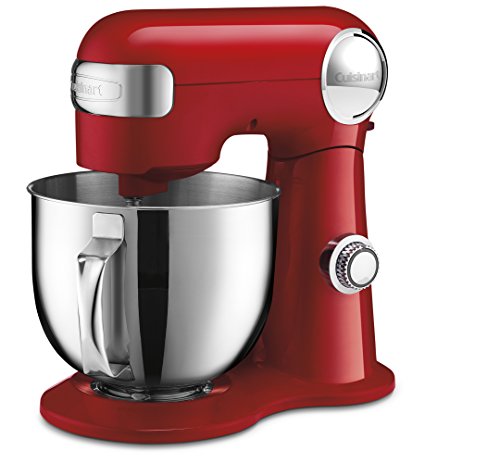
Cuisinart 12 Speed 5.5 Quart Stand Mixer
$216.65A 5.5 quart bowl and 12 speeds at roughly half the price of the equivalent KitchenAid, with a chef's whisk and flat paddle included rather than sold separately.
Best for: the most bowl capacity per dollar
Check price on AmazonAmazon prices move often, so check before you buy.
KitchenAid Artisan 5 Quart Tilt-Head Stand Mixer (KSM150PS) and Cuisinart 12 Speed 5.5 Quart Stand Mixer sit close in bowl size and speed count, and further apart in price than the spec sheet alone explains. The Cuisinart's 5.5 quart bowl is slightly larger than the KitchenAid's 5, it runs 12 speeds against 10, and it comes in at roughly half the KitchenAid's cost. What that price difference buys, and does not buy, is the actual question worth answering before choosing between them.
Two things separate the two brands beyond the raw numbers: KitchenAid publishes a flour capacity for its bowls and Cuisinart does not, and KitchenAid's tilt-head attachment hub, including the KitchenAid KFE5TS Flex Edge Beater for 4.5 and 5 Quart Tilt-Head Mixers, only fits KitchenAid's own 4.5 and 5 quart tilt-head mixers. Compare either mixer's bowl against a specific cake's needs in the mixer capacity calculator.
How do the specs actually compare?
| Model | Bowl (qt) | Speeds | Head type | Published flour capacity | Price |
|---|---|---|---|---|---|
| KitchenAid Artisan 5 Quart Tilt-Head Stand Mixer (KSM150PS) | 5 | 10 | Tilt head | 9 cups | $399.99 |
| Cuisinart 12 Speed 5.5 Quart Stand Mixer | 5.5 | 12 | Tilt head | Not published | $216.65 |
What does the price actually buy per quart of bowl space?
| Model | Price | Bowl (qt) | Price per quart |
|---|---|---|---|
| KitchenAid Artisan 5 Quart Tilt-Head Stand Mixer (KSM150PS) | $399.99 | 5 | $80.00 |
| Cuisinart 12 Speed 5.5 Quart Stand Mixer | $216.65 | 5.5 | $39.39 |
Do KitchenAid attachments fit a Cuisinart mixer, or the other way around?
No, in either direction. The KitchenAid KFE5TS Flex Edge Beater for 4.5 and 5 Quart Tilt-Head Mixers is built specifically for 4.5 and 5 quart KitchenAid tilt-head mixers and will not mount on a Cuisinart hub, and Cuisinart's own attachments are built to its own hub in the same closed way. Neither brand's parts cross over, so the accessory ecosystem is a real factor to weigh before buying into either ecosystem.
Which one holds up better for regular cake decorating use?
The consensus of verified owner reviews on both machines points the same direction: KitchenAid's tilt-head mixers are widely reported running for a decade or more of regular home baking, and parts such as beaters, whisks and replacement bowls are easy to source separately years after purchase. Cuisinart owners report good results for occasional baking, with fewer long-term reports at the volume a decorating business would put on a machine.
So which should you actually buy?
Buy Cuisinart 12 Speed 5.5 Quart Stand Mixer if you bake a few times a season and want a real stand mixer without paying for a brand's attachment ecosystem you will never use. Buy KitchenAid Artisan 5 Quart Tilt-Head Stand Mixer (KSM150PS) if you expect to add a flex edge beater, a spare bowl, or a grinder attachment down the line, or if you are baking often enough that long-term parts availability actually matters.
What this job actually needs
KitchenAid Artisan 5 Quart Tilt-Head Stand Mixer (KSM150PS)
$399.99The default decorating mixer: 10 speeds down to a stir that folds rather than throws, a 5 quart bowl rated for 9 cups of flour, and the tilt head that makes scraping a buttercream bowl quick.
Best for: the buy-once home mixer for cakes and buttercream
Check price on AmazonAmazon prices move often, so check before you buy.
Cuisinart 12 Speed 5.5 Quart Stand Mixer
$216.65A 5.5 quart bowl and 12 speeds at roughly half the price of the equivalent KitchenAid, with a chefs whisk and flat paddle included rather than sold separately.
Best for: the most bowl capacity per dollar
Check price on AmazonAmazon prices move often, so check before you buy.

KitchenAid KFE5TS Flex Edge Beater for 4.5 and 5 Quart Tilt-Head Mixers
$49.99A flexible silicone edge that wipes the bowl wall as it turns, which is the single attachment that most improves buttercream, because unmixed butter clinging to the side is what makes a batch look curdled.
Best for: buttercream and creaming butter and sugar
Check price on AmazonAmazon prices move often, so check before you buy.
Questions people ask
- Is a Cuisinart stand mixer as good as a KitchenAid for cake decorating?
- For occasional baking, yes, its 5.5 quart bowl and 12 speeds cover a two or three layer cake and buttercream without issue. It falls behind for a decorating business mainly on attachments, since KitchenAid's tilt-head ecosystem, including the flex edge beater, does not fit it, and on published capacity data, since Cuisinart does not state a flour-cup rating the way KitchenAid does.
- What is the price difference between KitchenAid and Cuisinart stand mixers?
- The KitchenAid Artisan runs about $400 for a 5 quart bowl, against roughly $217 for the Cuisinart's 5.5 quart bowl, which works out to about $80 a quart for the KitchenAid and $39 a quart for the Cuisinart. The Cuisinart is the better raw bowl-for-dollar value; the KitchenAid's price also buys a wider attachment ecosystem and a longer track record at high use.
- Do KitchenAid attachments fit a Cuisinart mixer?
- No. KitchenAid's tilt-head attachments, including the flex edge beater, are built specifically for the hub on its own 4.5 and 5 quart tilt-head mixers and do not mount on a Cuisinart machine. Cuisinart's attachments are equally specific to its own hub, so neither brand's parts cross over in either direction.
- Which stand mixer holds more batter, KitchenAid or Cuisinart?
- By raw bowl volume, the Cuisinart's 5.5 quart bowl is slightly larger than the KitchenAid Artisan's 5 quart bowl. KitchenAid publishes a 9 cup flour capacity for its bowl so a batter or meringue figure can be derived from it; Cuisinart does not publish an equivalent rating, so no comparable derived figure exists for its bowl.
- Is a Cuisinart mixer strong enough for stiff buttercream?
- Yes, at home batch sizes a 5.5 quart Cuisinart mixer with 12 speeds handles American buttercream and creamed butter without trouble. Where it may struggle relative to a KitchenAid is sustained daily use at a decorating business's volume, where owner reports favor KitchenAid's motor and part longevity over years of continuous work.
Related pages
How this page was put together
Researched from pan geometry, published manufacturer capacities, published serving conventions and university extension guidance. Not hands-on testing, and not professional advice.
Figures are labelled as derived, published or trade convention. Where no honest figure exists, the page says so rather than filling the gap.