Quick answer
Buttercream is the easier, more forgiving default: an 8 inch two layer cake takes about 5.5 cups for a crumb coat, final coat and piped borders. Ganache wins when the job needs a sharp edge or heat resistance, since a firm dark ganache runs 2 parts chocolate to 1 part cream by published couverture ratio and sets far harder.

Callebaut No. 811 Finest Belgian Dark Chocolate Callets, 1 kg
The reference dark couverture at about 54 percent, in callets that melt evenly, which is what the published tempering ranges on this site assume.
Best for: ganache, tempering and drips
Check price on AmazonFor an everyday layer cake, buttercream wins: it whips light, spreads easily, holds piped borders, and covers a 2 layer, 8 inch round cake for about 5.5 cups, roughly 2.8 lb, computed from the cake's 93.2 sq in of side and 50.3 sq in of top. Ganache wins the jobs buttercream cannot do as well: a shell that sets hard enough to hold a sharp edge under fondant, a glaze that survives a warm room without sliding, or a drip that has to stop exactly partway down the side.
The two are not really competing for the same job most of the time. Buttercream is a whipped fat, built to trap air and stay soft enough to pipe. Ganache is melted chocolate and cream, and it sets by chemistry rather than by whipping, which is why it holds a shape buttercream cannot and why it is measured in grams by weight rather than in cups. A firm dark ganache for a truffle centre or a panel runs 2 parts chocolate to 1 part cream by weight, a published ratio taken from couverture manufacturer charts, not a house convention. Scale either one in the frosting calculator or the ganache calculator.
Which one actually covers a cake better?
Buttercream and ganache solve different problems on the same cake, and the table below lines them up on the specifications that actually decide which one to reach for.
| Specification | American buttercream | Firm dark ganache |
|---|---|---|
| Measured by | Volume, in cups | Weight, in grams, never volume |
| Sets by | Cooling and crusting; stays soft | Cocoa butter crystallizing; sets hard |
| 8 in, 2 layer cake, full coat | 5.5 cups, about 2.8 lb | No single cup figure; scaled by area and ratio together |
| Holds a sharp 90 degree edge | Only with acrylic discs and chilling | Yes, once set, without extra tooling |
| Room temperature behavior | Softens visibly in heat | Holds firmer than buttercream in the same room |
| Piped borders and rosettes | Yes, its main strength | Poor; too dense and unstable while soft |
| Ingredient cost per cake | Lower, mostly butter and sugar | Higher, driven by couverture chocolate |
How much buttercream does covering a cake take?
Every figure below comes from the cake's own surface area, not a flat per-inch guess. Side area on a round cake grows with both diameter and height, so a taller cake reads noticeably higher even at the same diameter.
| Cake size | Buttercream (cups) | Approx weight (lb) |
|---|---|---|
| 6 in round | 3.6 | 1.8 |
| 8 in round | 5.5 | 2.8 |
| 9 in round | 6.6 | 3.3 |
| 10 in round | 7.7 | 3.9 |
| 12 in round | 10.2 | 5.1 |
How much chocolate and cream does ganache take?
Ganache scales from a ratio, not a coverage chart, and the ratio itself changes with the chocolate. These are the published figures for a firm set, the closest ganache equivalent to a final buttercream coat, one that cuts cleanly rather than staying soft.
| Chocolate type | Ratio, chocolate:cream | Chocolate (g) | Cream (g) |
|---|---|---|---|
| Dark, 54 to 70 percent | 2:1 | 400 | 200 |
| Milk, 31 to 40 percent | 3:1 | 400 | 133 |
| White, 28 to 35 percent cocoa butter | 4:1 | 400 | 100 |
Which one holds up better in a warm room?
Neither one is heatproof, but they fail differently, and the failure point is worth knowing before an outdoor event.
American buttercream, the most common type, is mostly butter and powdered sugar, and butter has a melting range that starts well below body temperature, so a hot room turns a crisp edge soft and eventually greasy. Swiss and Italian buttercream, which use a cooked meringue base, hold their shape noticeably longer in the same room; the trade-off between the three buttercream types is its own comparison, covered on the American vs Swiss vs Italian buttercream page.
A set ganache behaves differently again, failing by softening rather than melting outright until the room passes the working range a couverture manufacturer publishes for tempering, roughly 88 to 90 F for dark chocolate and a few degrees cooler for milk or white. Past that, a ganache shell softens the way a chocolate bar does in a hot car. For a shell that has to survive an outdoor summer event, dark ganache is the more heat-stable of the two, and tempering the chocolate itself first, rather than just melting it into cream, makes the shell noticeably firmer; see the chocolate tempering calculator for the published ranges by chocolate type.
Before this cake leaves the kitchen
Once cream goes into a ganache it is a dairy product and should be treated that way: refrigerate a soft ganache filling or frosting if the finished cake will sit out more than a couple of hours, and let it come back toward room temperature before serving so it is not stiff and cold when cut. Plain American buttercream is more forgiving at room temperature for the length of a party, though it softens visibly in a warm room, which is a structural problem rather than a food safety one. Cream cheese frostings and anything whipped with fresh cream need refrigeration regardless of which base coat sits under them. Ask about allergies before baking for someone else, since a dairy or chocolate allergy affects both of these frostings, and selling either one is governed by your state's cottage food law, which varies.
What this job actually needs
Callebaut No. 811 Finest Belgian Dark Chocolate Callets, 1 kg
$44.85The reference dark couverture at about 54 percent, in callets that melt evenly, which is what the published tempering ranges on this site assume.
Best for: ganache, tempering and drips
Check price on AmazonAmazon prices move often, so check before you buy.

Ateco Offset Spatula, 9.75 in Stainless Steel Blade, Wood Handle
$15.38Long enough to span a 10 or 12 inch tier in a single sweep, which is how you get a flat top without the ridges that a short blade leaves.
Best for: flat tops on large tiers
Check price on AmazonAmazon prices move often, so check before you buy.
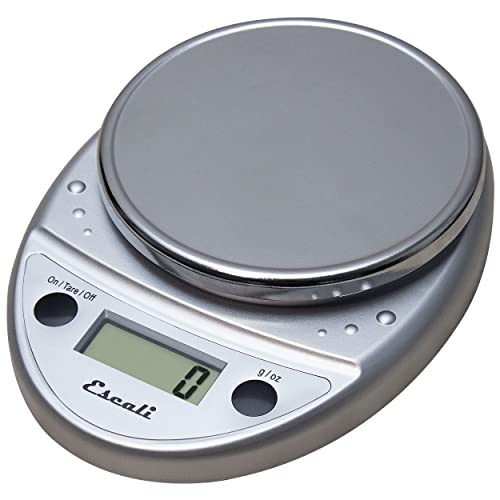
Escali Primo Digital Food Scale
$25.00The scale most often on a professional bench: it reads fast, tares instantly, and nothing about it is trying to also be a nutrition tracker.
Best for: weighing every ingredient, which is what makes scaling a recipe work
Check price on AmazonAmazon prices move often, so check before you buy.
Questions people ask
- Is ganache better than buttercream for covering a cake?
- Neither is universally better; they suit different jobs. Buttercream whips light, pipes borders, and is the easier default for an everyday cake, covering an 8 inch two layer cake for about 5.5 cups. Ganache sets harder by chemistry rather than by whipping, so it holds a sharp edge and survives heat better, which is why bakers reach for a firm dark ganache, 2 parts chocolate to 1 part cream by weight, under fondant or for a shell that has to travel.
- Can you use ganache instead of buttercream under fondant?
- Yes, and many bakers prefer it. Ganache sets firmer than buttercream, so it holds the cake's shape truer once the fondant goes on top and resists dents from handling better. A firm ganache for this job runs about 2 parts chocolate to 1 part cream by weight for dark chocolate, or 3 to 1 for milk chocolate, both published couverture ratios. The trade-off is that ganache needs to be made ahead and cooled to the right consistency, while buttercream can be spread and covered the same hour.
- Does ganache need to be refrigerated the way buttercream does not?
- Once cream is mixed in, ganache is a dairy product and should be refrigerated if the finished cake sits out for more than a couple of hours, then brought back toward room temperature before serving. Plain American buttercream is more forgiving at room temperature for the length of a party, since it contains no cream, though it does soften visibly in a warm room. A firm ganache made for a shell or truffle centres holds up at room temperature longer than a soft, cream-heavy version.
- Why is ganache measured in grams and buttercream in cups?
- Because ganache is a ratio of two ingredients by weight, chocolate to cream, and that ratio only behaves correctly on a scale; a cup of chopped chocolate and a cup of melted chocolate are different weights, so measuring by volume produces an unpredictable set. Buttercream is not built on a strict ratio the same way, and coverage for a cake is really a surface area question, so cups tied to crumb coat and final coat thickness are the more useful unit for a home baker to shop and plan around.
- Which is cheaper, buttercream or ganache?
- Buttercream is almost always cheaper, since butter and powdered sugar cost far less by weight than couverture chocolate. Covering an 8 inch, 2 layer cake in buttercream runs about 2.8 lb of ingredients built mostly from pantry staples. The same cake in a firm dark ganache needs roughly the weight of the chocolate itself plus half again in cream, and real couverture chocolate runs well past the cost of butter and sugar per pound.
Related pages
How this page was put together
Researched from pan geometry, published manufacturer capacities, published serving conventions and university extension guidance. Not hands-on testing, and not professional advice.
Figures are labelled as derived, published or trade convention. Where no honest figure exists, the page says so rather than filling the gap.