Quick answer
The ThermoWorks Thermapen ONE, about $125.00, is the pick for baking and sugar work: it reads in about one second, which matters most for Swiss and Italian meringue where the syrup keeps climbing while you hold a whisk in the other hand. Cheaper clip and oven thermometers cover candy-making and oven accuracy for far less.

ThermoWorks Thermapen ONE Instant-Read Thermometer
A one second reading is what makes it usable for Swiss and Italian meringue, where you are holding a whisk in one hand and the sugar syrup is still climbing in temperature.
Best for: Swiss and Italian meringue, and sugar work
Check price on AmazonFor baking and sugar work, the ThermoWorks Thermapen ONE Instant-Read Thermometer at $125.00 is the pick. Sugar work does not forgive a slow thermometer: a syrup can climb several degrees in the time a cheap probe takes to settle, and by then you have missed the soft-ball or soft-crack stage the recipe needed.
Not every job on this list needs a $125 instant-read thermometer, though. An oven that runs cold ruins more cakes than a slow candy thermometer ever will, and the tiers below split the picks by job rather than by price alone.
This list actually covers three separate tools wearing one label: an instant-read probe for meringue and syrup, a clip-on programmable thermometer for candy work left unattended on the stove, and a dial thermometer that just sits in the oven and tells you the truth about its temperature. Almost nobody needs all three at once, so the picks below are grouped by job rather than assuming every baker wants the same thermometer.
What thermometers does a first baking setup need?
Two cheap thermometers solve two separate, common problems: an oven that lies about its own temperature, and a sugar syrup that needs a target number rather than a guess.
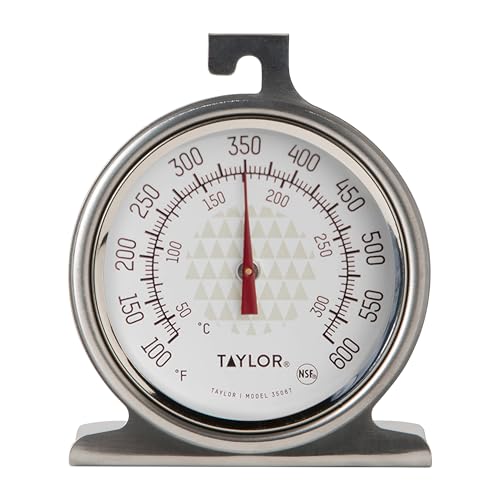
Taylor Large 2.5 Inch Dial Oven Thermometer
$8.28Home ovens routinely run 25 F or more off their dial, which is the real reason a bake time chart never matches your oven, and this is the cheapest way to find out by how much.
Best for: finding out what your oven actually does
Check price on AmazonAmazon prices move often, so check before you buy.

Taylor Programmable Digital Candy and Deep Fry Thermometer
$12.49It clips to the pan and alerts at a set temperature, which is what you want for Italian meringue syrup because the window between 238 and 248 F goes past quickly.
Best for: Italian meringue syrup and candy work
Check price on AmazonAmazon prices move often, so check before you buy.
Which thermometer is worth upgrading to?
The upgrade here is speed and surface reading rather than a wider temperature range, since cake and sugar work both live in a fairly narrow band.
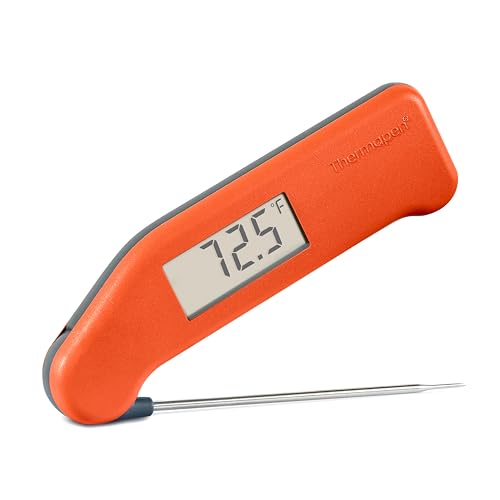
ThermoWorks Classic Thermapen Instant-Read Thermometer
$105.00The older Thermapen at a lower price, slower to read than the ONE but with the same probe accuracy, which is the part that matters for tempering.
Best for: accurate readings without the flagship price
Check price on AmazonAmazon prices move often, so check before you buy.

Etekcity Infrared Thermometer Laser Temperature Gun 774
$18.99An infrared gun reads the surface of a chocolate bowl without putting a probe in it, which is how you check a temper without seeding the chocolate off a cold probe.
Best for: checking chocolate surface temperature
Check price on AmazonAmazon prices move often, so check before you buy.
Is the flagship Thermapen worth it for cake decorating?
For most cake baking, no. For anyone doing Italian or Swiss meringue buttercream or sugar work regularly, the one second read time is a real, felt difference rather than a marginal upgrade.
ThermoWorks Thermapen ONE Instant-Read Thermometer
$125.00A one second reading, which is what makes it usable for Swiss and Italian meringue where you are holding a whisk in the other hand and the syrup is still climbing.
Best for: Swiss and Italian meringue, and sugar work
Check price on AmazonAmazon prices move often, so check before you buy.
Who should not buy this
The Thermapen ONE is not worth the price for someone who only checks oven temperature or makes candy once or twice a season. That job is fully covered by the Taylor Large 2.5 Inch Dial Oven Thermometer or the Taylor Programmable Digital Candy and Deep Fry Thermometer for a fraction of the cost.
Which sugar stage does each thermometer actually need to catch?
Meringue and buttercream syrup work in a narrow band, usually somewhere between 235 F and 248 F depending on the recipe, which is the soft-ball to firm-ball range. A slow thermometer is genuinely dangerous to a batch here, not because of safety but because the syrup keeps climbing while the display catches up, and a few seconds of lag can carry you straight past the target into a stage that will not whip into a stable buttercream.
Chocolate tempering lives in a much cooler, tighter band again, with dark couverture typically melted to around 115 to 120 F, cooled to about 82 to 84 F, and brought back to roughly 88 to 90 F to work. That is close enough that an infrared reading of the bowl surface is often more useful day to day than a probe stuck into a small volume of chocolate.
How do these compare on the numbers?
| Model | Type | Notable spec | Price |
|---|---|---|---|
| ThermoWorks Thermapen ONE | Instant-read probe | 1 second read time | $125.00 |
| ThermoWorks Classic Thermapen | Instant-read probe | Not published read time | $105.00 |
| Taylor Programmable Candy and Deep Fry | Clip-on programmable | Alerts at a set temperature | $12.49 |
| Taylor Dial Oven Thermometer | Dial oven | 2.5 in dial | $8.28 |
| KitchenAid Dial Oven Thermometer | Dial oven | 3 in dial, 100 to 600 F range | $16.99 |
| Etekcity Infrared 774 | Infrared gun | Surface reading, no probe contact | $18.99 |
How we chose
Every thermometer above was researched from published manufacturer specifications: probe type, published read time where the maker states one, and named features such as programmable alerts or infrared sensing. The consensus of verified owner reviews was used to confirm which models hold their calibration and which drift with regular use. None were tested against a certified reference for this page. This is researched from published specifications and owner-review consensus, not a lab comparison.
Buying tips
Check your oven before you blame a recipe. A cheap dial oven thermometer catches the single most common cause of underbaked or overbaked cake, which is an oven that reads 350 F on its dial and runs 25 F or more away from that in either direction.
For sugar syrup, a slow thermometer is worse than no thermometer, because it gives you false confidence right up until the syrup overshoots the stage you needed. Clip a probe to the pan rather than dipping in and out with a handheld one.
Swiss and Italian meringue methods heat egg whites well above room temperature, but a thermometer only confirms you hit the recipe's target, it does not make raw egg safe on its own. Swap in pasteurized egg whites or meringue powder if the cake is going to children, older guests or anyone pregnant.
Wipe a probe thermometer clean between uses, especially when it moves between raw egg mixtures and finished chocolate or syrup, and let a hot syrup thermometer cool before you wash it rather than plunging it straight into cold water, which can crack a glass-stemmed model.
What this job actually needs

Callebaut No. 811 Finest Belgian Dark Chocolate Callets, 1 kg
$44.85The reference dark couverture at about 54 percent, in callets that melt evenly, which is what the published tempering ranges on this site assume.
Best for: ganache, tempering and drips
Check price on AmazonAmazon prices move often, so check before you buy.

Chocolate World CW2295 Polycarbonate Candy Mold, 32 Dome Cavities
$33.05Polycarbonate is rigid and takes a polish, which is what gives tempered chocolate its shine; a flexible silicone mould gives a dull finish no matter how good the temper is.
Best for: shiny tempered chocolate decorations
Check price on AmazonAmazon prices move often, so check before you buy.
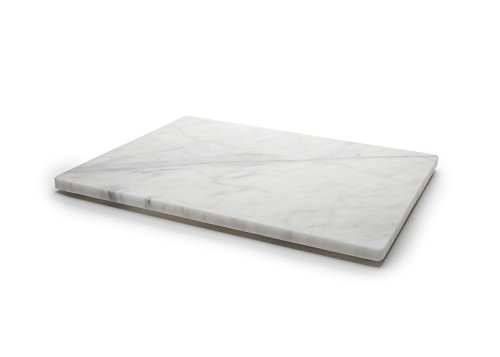
Fox Run Marble Pastry Board, 16 x 20 in
$70.39Marble stays below room temperature, which is why it is the traditional surface for tempering chocolate by tabling and for rolling fondant without it going sticky.
Best for: tabling chocolate and rolling fondant
Check price on AmazonAmazon prices move often, so check before you buy.
Questions people ask
- Do I need an instant-read thermometer for baking cake, or just for candy?
- Mostly for candy and sugar work. A layer cake rarely needs an internal temperature check; the doneness tests, such as a clean skewer and a springy center, tell you more. An instant-read thermometer earns its price on caramel, sugar syrup, and Swiss or Italian meringue, where a few degrees separate one stage from the next.
- Why does my candy thermometer read differently from a recipe's chart?
- Elevation and calibration are the usual reasons. Sugar syrup boils at a lower temperature at higher elevation, so every stage on a sea-level chart shifts down. Clip-on thermometers can also drift out of calibration over time; test yours in boiling water, which should read 212 F at sea level, and adjust your target stages if it does not.
- Can I check chocolate temper without an infrared thermometer?
- Yes, with an instant-read probe touched briefly to the surface, though an infrared gun is faster and does not risk seeding the chocolate with a cold probe tip. Either way, temperature alone does not confirm a good temper; a small test smear that sets glossy and snaps cleanly within a few minutes is the real check.
- How much does read time actually matter for a home baker?
- It matters most in sugar work, where a syrup can climb several degrees in the two or three seconds a slow probe takes to settle, enough to overshoot soft-ball into firm-ball. For general oven baking, a slower thermometer is a minor inconvenience rather than a real problem, since cake temperatures change gradually by comparison.
- What temperature should I temper dark chocolate to?
- Melt it to roughly 115 to 120 F, cool it to about 82 to 84 F to encourage the right crystal structure, then bring it back up to around 88 to 90 F to work with. These are published manufacturer ranges for dark couverture; milk and white chocolate temper a few degrees cooler at every stage because they carry less cocoa solids and cocoa butter.
Related pages
How this page was put together
Researched from pan geometry, published manufacturer capacities, published serving conventions and university extension guidance. Not hands-on testing, and not professional advice.
Figures are labelled as derived, published or trade convention. Where no honest figure exists, the page says so rather than filling the gap.