Quick answer
A quarter sheet (9 x 13 in), 1 in deep pan takes about 5.4 cups of batter. That is the pan filled two thirds full, which is the working convention, out of 8.1 cups to the rim. Filled that far the batter sits 0.67 inches deep before it rises.
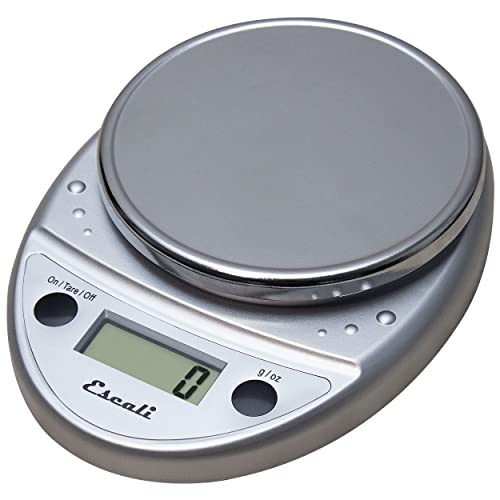
Escali Primo Digital Food Scale
The scale most often on a professional bench: it reads fast, tares instantly, and nothing about it is trying to also be a nutrition tracker.
Best for: weighing every ingredient, which is what makes scaling a recipe work
Check price on AmazonA quarter sheet (9 x 13 in), 1 in deep pan holds 8.1 cups to the rim, and you want 5.4 cups of batter in it. The gap is deliberate: filling two thirds full leaves the room a cake needs to climb without going over the wall or doming into a peak you then have to cut off and throw away.
Scale a recipe to this pan with the recipe scaling calculator, or check what it would take in a different pan on the pan substitution pages.
How much batter does a quarter sheet (9 x 13 in), 1 in deep pan hold?
| Fill level | Batter (cups) | Batter depth (in) | What happens |
|---|---|---|---|
| Half full | 4.05 | 0.5 | A shallow layer, fine for a thin torte layer |
| Two thirds full | 5.4 | 0.67 | The working convention, room to rise without spilling |
| Three quarters full | 6.08 | 0.75 | Usually still safe, expect more doming |
| Full to the rim | 8.1 | 1 | It will go over the side, and the middle will not set |
Is filling a pan two thirds full a rule or a convention?
A convention, and a useful one. Nothing physical happens at exactly two thirds. What is real is that most cake batters expand by somewhere between a quarter and a half as the leavening works and the water turns to steam, so a pan filled two thirds leaves enough room and a pan filled to the top does not.
A batter you know rises hard, such as a genoise or anything with whipped egg white, is worth filling to half. A dense batter such as a mud cake or a pound cake can take three quarters comfortably.
| Batter type | Suggested fill | Reason | Basis |
|---|---|---|---|
| Butter or oil layer cake | Two thirds | Moderate rise, the default assumption everywhere | Trade convention |
| Genoise or chiffon | One half to two thirds | Whipped egg expands hard and fast in the first minutes | Trade convention |
| Mud cake or pound cake | Three quarters | Dense, low leavening, very little climb | Trade convention |
| Cheesecake | Three quarters or more | Sets rather than rises, and a water bath limits the top anyway | Trade convention |
What else can I do with this much batter?
5.4 cups of batter is a quantity, not a cake, and it can go into other things.
| Instead of this pan | Yield | Basis |
|---|---|---|
| Standard cupcakes | 21 cupcakes | Trade convention, a quarter cup of batter each |
| Mini cupcakes | 64 minis | Trade convention, about a tablespoon and a half each |
| Jumbo cupcakes | 10 jumbo | Trade convention, a half cup each |
Before this cake leaves the kitchen
A few things worth knowing before this cake leaves the kitchen. Cream cheese frostings and anything with whipped cream need refrigeration, and plain buttercream softens in a warm room long before it is unsafe, which is a structural problem rather than a health one. Royal icing made with raw egg white, and mousses set with raw egg, are worth swapping for pasteurised egg white or meringue powder when you are baking for children, older guests or anyone pregnant. If you are baking for other people, ask about allergies before you start rather than after, because cross contact happens at the mixing bowl and not at the table. And if you are selling rather than giving cakes away, that is governed by your state cottage food law, which varies a great deal and is worth reading once properly.
What this job actually needs
Escali Primo Digital Food Scale
$25.00The scale most often on a professional bench: it reads fast, tares instantly, and nothing about it is trying to also be a nutrition tracker.
Best for: weighing every ingredient, which is what makes scaling a recipe work
Check price on AmazonAmazon prices move often, so check before you buy.

Fat Daddio's Anodized Aluminum Round Cake Pans, 8 x 2 in, 2 Piece Set
$24.69Two matched 8 by 2 inch pans, which is exactly one two layer cake, in the anodized aluminum that bakes flatter than a dark nonstick pan because it reflects rather than absorbs.
Best for: the standard two layer 8 inch cake
Check price on AmazonAmazon prices move often, so check before you buy.

Wilton Bake-Even Cake Strips, 2 Piece Set
$10.99Damp strips around the pan slow the outside so the middle catches up, which is what stops a dome forming and saves you levelling off the top and throwing it away.
Best for: flat layers with no trimming
Check price on AmazonAmazon prices move often, so check before you buy.
Questions people ask
- What happens if I overfill a quarter sheet (9 x 13 in), 1 in deep pan?
- Two things, and the second is worse. The batter climbs over the wall and burns onto the oven floor, which is a mess but survivable. More importantly the extra depth means the middle takes far longer to set while the outside is already done, so you end up with a dark crust around a sunken, underbaked centre. Pour the excess into a cupcake liner instead.
- How do I measure 5.4 cups of batter accurately?
- Weigh it rather than measuring by volume. Put the empty pan on a scale, tare it, and pour until you reach the weight you want; batter is thick and traps air, so a measuring cup reading is never quite what you think. If you are splitting one batch across two pans, weighing is the only reliable way to get two layers the same height.
- Can I work out the capacity of a pan I cannot identify?
- Yes, and it is the most useful trick in baking. Fill the pan with water from a measuring jug and record how much it takes to reach the rim. That gives you the rim capacity directly, which for this pan is 8.1 cups, and two thirds of whatever you measure is your batter figure. It works for novelty and character pans where no published capacity exists.
Related pages
- How Much Batter for a Half sheet (13 x 18 in), 1 in deep Pan?
- How Much Batter for a 9.5 inch bundt, 3.5 in deep Pan?
- How Much Batter for a 9 x 13 inch rectangle, 2 in deep Pan?
- How Much Batter for a 9 inch square, 2 in deep Pan?
- How Much Batter for a 9 inch springform, 3 in deep Pan?
- How Much Batter for a 9 inch round, 3 in deep Pan?
How this page was put together
Researched from pan geometry, published manufacturer capacities, published serving conventions and university extension guidance. Not hands-on testing, and not professional advice.
Figures are labelled as derived, published or trade convention. Where no honest figure exists, the page says so rather than filling the gap.